2024 News Briefs
Insights from the Bench: Justices Kagan, Kavanaugh, and Barrett Visit Notre Dame

Throughout the past few years, Notre Dame Law School has welcomed several Supreme Court Justices, each enriching the Law School community with thoughtful perspectives on the law and judiciary.
U.S. Supreme Court Justice Brett Kavanaugh spoke at the 2023 Notre Dame Law Review Federal Courts Symposium, discussing various topics including administrative law, the Chevron doctrine, and his experiences on the Supreme Court.
In a conversation with Dean G. Marcus Cole, Kavanaugh described how his Catholic education has shaped his commitment to judicial integrity, underscoring principles of empathy, careful reasoning, and respect for various perspectives. He also spoke about the unique relationship the nine justices have, highlighting their shared spirit of compromise and congeniality that guides them in assembling an opinion. He has also taught two short courses at the Law School over the past year.
Kavanaugh returned to Notre Dame Law School this November to judge the final round of the inaugural Justice Amy Coney Barrett Moot Court Tournament.

U.S. Supreme Court Justice Elena Kagan visited Notre Dame, where she co-taught a criminal law class and joined Dean Cole for a live-streamed talk to launch the 2023-24 Notre Dame Forum on “The Future of Democracy.” Kagan shared insights into democracy, originalism, and judicial responsibility.
She emphasized the Court’s role in protecting democratic structures and highlighted the importance of civil discourse. Kagan’s visit to Notre Dame provided a rare opportunity to learn from a Justice committed to protecting and advancing democratic principles.
U.S. Supreme Court Justice Amy Coney Barrett ‘97 J.D. and Israel Supreme Court Justice Alex Stein visited Notre Dame Law School earlier this year to discuss legal interpretation within their respective legal systems.

Justice Stein advocated for a strict, positivist approach to Israeli law, stressing judges’ adherence to existing laws without introducing new rules. Justice Barrett, an originalist
in constitutional interpretation, compared constitutional and statutory interpretation in the U.S., highlighting the U.S. Constitution’s strength through its concise nature. Barrett also taught two short courses to students over the past year.
These visits from the Justices underscore Notre Dame Law School’s deep-seated commitment to fostering dialogues on the role of law and the judiciary, offering law students unique access to some of the nation’s most influential legal minds.
Notre Dame Law Review Celebrates 100 Years

The 2024–25 academic year marks the centennial of the Notre Dame Law Review, celebrating 100 years of exceptional legal scholarship. To commemorate the milestone, the Law Review hosted a weekend celebration in October, bringing together alumni, faculty, and current students for several events, including an editors-in-chief panel discussion.
The panel featured former editors-in-chief: Judge Thomas D. Schroeder ’84 J.D., U.S. District Court Judge for the Middle District of North Carolina; Anthony J. Bellia Jr. ’94 J.D., O’Toole Professor of Constitutional Law at Notre Dame Law School; and Leon F. DeJulius Jr. ’02 J.D., New York Partner-in-Charge at Jones Day. Professor Derek Muller ’07 J.D. delivered opening remarks, and the panel was moderated by Alicia Armstrong, current editor-in-chief of the Notre Dame Law Review.
A Pathway to Prestigious Clerkships
ND Law School has a strong tradition of placing graduates in prestigious judicial clerkships, which provide invaluable experience, mentorship, and a jumpstart to legal careers.
Each year, our students and alumni secure clerkships in federal, state, and specialized courts across the country, with notable placements at the U.S. Supreme Court. In recent years, the Law School has consistently ranked among the top law schools nationally for federal clerkships. In 2023, 18% of our graduates secured federal clerkships for the term immediately following their graduation, placing the Law School fourth in the nation for federal clerkship placement for the second consecutive year.
This success is thanks in part to the Law School’s Career Development Office, which now includes a full-time staff member dedicated to supporting students and alumni in their pursuit of clerkships, as well as the faculty-led clerkship committee, chaired by Professor Nicole Stelle Garnett. Our faculty members—many of whom have clerked in the U.S. Supreme Court or other federal courts— offer personalized guidance, mock interviews, and concentrated classes to prepare students for their clerkship.
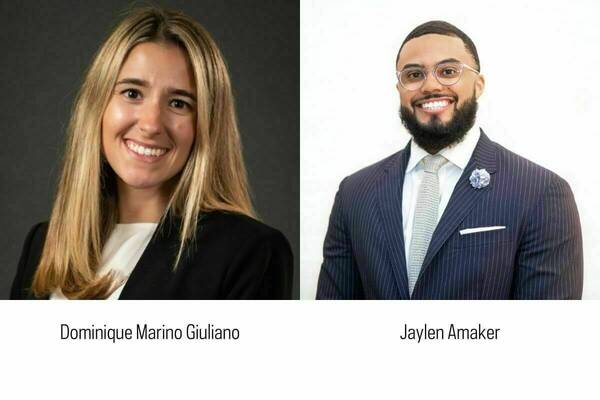
Recent graduates like Dominique Marino Giuliano ’23 J.D., who clerked for Judge John Blakey ’88, ’92 J.D., highlight the long-term benefits of clerking. “I’ve gained invaluable insights into judicial decisionmaking and developed skills I’ll carry throughout my career,” Giuliano said. She will clerk a second time with Judge Paul Matey of the U.S. Court of Appeals for the Third Circuit during the 2026-27 term.
Jaylen Amaker ’22 J.D., who has clerked for Judge David J. Hale of the U.S. District Court for the Western District of Kentucky and later Judge Denny Chin of the U.S. Court of Appeals for the Second Circuit, has also seen the value of clerking. “I applied for a clerkship because I value mentorship. Judges are the best of the profession, and I wanted the opportunity to learn at the hands of a master,” Amaker said.
“We are very proud of our students’ success in securing clerkships. No matter a student’s intended path within the law, clerkships provide invaluable experience and mentorship in the early stages of their legal career,” said Vincent Versagli, director of the career development office.

With a growing number of graduates pursuing clerkships, Notre Dame continues to build on its reputation as a leading law school for judicial placements, helping students open doors to careers in some of the country’s most prestigious courts.
Kari Lorentson ’19 J.D. and Elizabeth Totzke ’22 J.D. are clerking for Justice Amy Coney Barrett during the 2024-25 term.
They are joined by two Notre Dame Law School faculty members on the Court this term: Professor Christian Burset, who is clerking for Justice Neil Gorsuch, and Associate Professor Rev. Patrick Reidy, C.S.C., ’08, who is clerking for Justice Brett Kavanaugh.
Over the past six terms, six Notre Dame Law alumni have served as clerks at the Supreme Court. In addition to Lorentson and Totzke, Laura Wolk ’16 J.D. clerked for Justice Clarence Thomas, Audrey Beck ’17 J.D. clerked for Justice Brett Kavanaugh, Alexa Baltes ’17 J.D. clerked for Justice Brett Kavanaugh, and Timothy Bradley ’20 J.D. clerked for Justice Amy Coney Barrett.
New Intellectual Property Externship
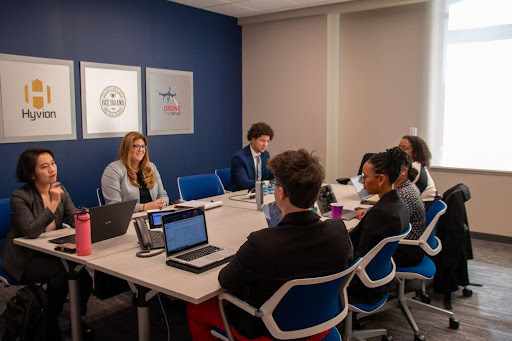
This past spring, the Law School launched a new Intellectual Property (IP) Externship, offering students the opportunity to represent small businesses in patent, trademark, and copyright matters.
Alumna Jenna Tracy ’19 J.D., an IP and trademark attorney at Lowenstein Sandler, spearheads the program. During her time in law school, Jenna took every available IP course and participated in the Intellectual Property and Entrepreneurship Clinic. Inspired by her experiences, she was eager to give back and help current students gain similar opportunities.
The semester-long program combines a weekly seminar with practical client work, focusing on skills such as case management, attorney-client relationships, and substantive IP law. The externship provides a valuable bridge to students between classroom learning and the practice of IP law.

G. Marcus Cole Reappointed as Dean
G. Marcus Cole was reappointed as the Joseph A. Matson Dean and Professor of Law at Notre Dame Law School for a second five-year term, beginning on July 1, 2024.
Since assuming the role as dean in 2019, Dean Cole has significantly enhanced the Law School’s programs and diversity. Under his leadership, the Law School has seen major growth and innovation, including the creation of the Lindsay and Matt Moroun Religious Liberty Clinic, which advocates for religious freedom in U.S. and international courts, including the U.S. Supreme Court. In 2020, Dean Cole launched the Exoneration Justice Clinic, which focuses on securing justice for the wrongfully convicted and has doubled its capacity to support clients through substantial grants. Last year, the Law School opened the Global Human Rights Clinic, amplifying its impact on human rights issues globally.
Dean Cole has also expanded Notre Dame’s global footprint through the Global Lawyering Initiative, positioning the Law School as a leader in international legal education. This initiative has expanded exchange programs worldwide, including in the Global South, and bolstered programs such as the highly successful London Law Programme.
Additionally, Dean Cole has overseen the enrollment of the most diverse student bodies in the Law School’s history. Under his leadership, the Law School has fostered a culture of dignity and respect, preparing students to meet the challenges of being a Notre Dame lawyer and to serve the world with integrity and compassion.
“I am the most blessed man in the world that I get to be part of this amazing community,” Dean Cole said after his reappointment. “We strive to be a force for good in service to God, His people, and Our Lady’s University.”
Dean Cole's Honors and Awards
Received the St. Thomas More Medal by Lord Nicolas Windsor, cousin of King Charles III, and inducted into the Fellowship of God’s Good Servant at Stonyhurst College (during address to the House of Lords, London, 2024)
Awarded the Dignitatis Humanae Award by the University of St. Thomas School of Law (2024)
IBJ Media’s Indiana 250, list of the state’s most influential and impactful leaders (2024, 2023)
The American College of Bankruptcy (inducted in 2022)

Lardy Scholarship Award: Hadiah Mabry
Hadiah Mabry, a third-year student, was selected to receive the prestigious Peter A.R. Lardy Scholarship Award for the 2024-25 academic year. The award, established by the Notre Dame Law Class of 1975, honors the memory of their classmate Peter Lardy, who passed away from cancer during his third year of law school. It is presented annually to a rising third-year student who exemplifies courage, love, and understanding toward others. The scholarship includes significant tuition assistance for the recipient’s final year of law school.
Mabry, who was nominated by members of the Law School community, was praised for her unwavering kindness, deep commitment to her Catholic faith, and ability to remain graceful amid immense personal difficulty. Last year, Mabry’s husband was diagnosed with cancer, and many noted how she continued to offer encouragement and support to her peers while navigating her own challenges.
“Receiving the Lardy Scholarship is an incredible honor,” Mabry said. “It is a confirmation of God’s goodness and faithfulness in my life.” In addition to her strength and generosity, Mabry is known for her commitment to service. She was drawn to law school as a means to help others, and she has been involved in the Lindsay and Matt Moroun Religious Liberty Clinic, the Education Law Forum, the Notre Dame Law Review, the St. Thomas More Society, and the Women’s Legal Forum. After graduation, Mabry will clerk for the Honorable Joan Larsen in the U.S. Court of Appeals for the Sixth Circuit.
Mabry reflects on her experience at Notre Dame, saying, “Being a ‘different kind of lawyer’ means seeing your client with innate human dignity, equal before God. I am so incredibly grateful to be at Notre Dame. There is no place else in the world where I’d rather be.”

Expanded Global Reach with Three New Partnerships
Notre Dame Law School significantly expanded its global academic reach through new partnership agreements over the last year with the University of Cape Town, the University of Lucerne, and Paris-Panthéon-Assas University. These collaborations will foster greater international study, research, and faculty exchanges, aligning with the Law School’s commitment to global academic excellence and its Global Lawyering Initiative.
The partnership with the University of Cape Town marks a historic milestone in the Law School’s international efforts. The agreement focuses on faculty collaboration and joint research, particularly in the field of human rights law.
This partnership follows a 2023 visit by a Law School delegation to South Africa that coincided with the 50th anniversary of the formation of the Law School’s LL.M. Program in International Human Rights Law. Notre Dame’s partnerships with the University of Lucerne and Paris-Panthéon-Assas University similarly aim to enhance academic exchanges and collaborative research. The memorandum of understanding with Lucerne will strengthen faculty and student exchanges, while the renewed agreement with Paris-Panthéon- Assas continues to foster opportunities for joint projects and international collaborations.
These strategic partnerships not only enhance Notre Dame’s international presence, but also provide invaluable opportunities for faculty and students to engage in research and study at leading global institutions.
Notre Dame Law School Religious Liberty Clinic Named the Lindsay and Matt Moroun Religious Liberty Clinic
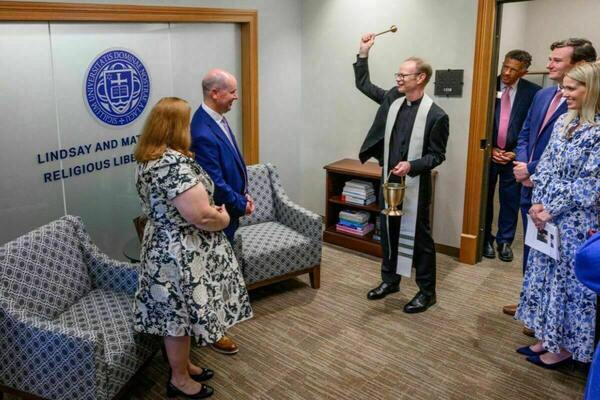
Notre Dame Law School announced that its Religious Liberty Clinic will now be named the Lindsay and Matt Moroun Religious Liberty Clinic, in recognition of the Morouns’ significant gift.The announcement was made during the fourth annual Notre Dame Religious Liberty Summit, which brings together global leaders in religious freedom from a variety of diverse sectors. University President Rev. Robert A. Dowd, C.S.C. dedicated and blessed the newly renamed Clinic in the presence of the Moroun family and Clinic faculty and staff.
Established in 2020, the Clinic is focused on defending religious freedom. It represents individuals and organizations from all faith traditions, working to protect the constitutional right to religious belief and practice.
“Without the Morouns’ vision and leadership, we could not have initiated or sustained this crucial work,” said Dean G. Marcus Cole. “Their generosity and commitment to faith as a guiding principle have been central to our success.”
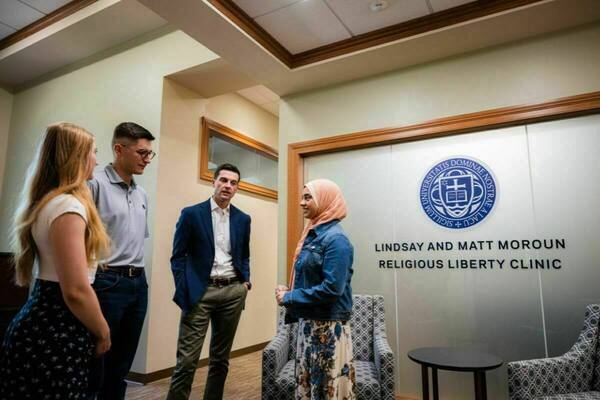
The Clinic provides students with hands-on experience in promoting religious freedom, both domestically and abroad. Recent projects include advocating for Indigenous religious rights, representing immigrants seeking asylum from religious persecution, fighting religious discrimination, defending religious exercise in prison, and supporting ministries in Africa.
Professor John Meiser ’07, ’10 J.D., director of the Clinic, expressed gratitude to the Morouns for their support, which has enabled students to participate in meaningful legal work protecting religious freedoms. “I am deeply grateful to the Moroun family, whose generosity has enabled us to give our students unparalleled opportunities to serve people in need and to participate in this critical work to protect our most foundational freedom.”

Notre Dame Law School’s Fight to Protect Oak Flat from Destruction
Notre Dame Law School’s Lindsay and Matt Moroun Religious Liberty Clinic has filed several amicus briefs urging courts to recognize that Indigenous sacred sites are entitled to the same religious liberty protections as all other houses of worship under federal law.
Oak Flat, known by the Apache people as Chi’chil Biłdagoteel, is an area in Arizona that contains hundreds of Indigenous archaeological sites and burial grounds. Revered by Native tribes as a place where holy springs flow from the earth and where holy beings reside, Apaches have long worshiped and held religious ceremonies there.
In 2014, Congress mandated the transfer of the land to Resolution Copper, a foreign-owned mining company, which threatens to destroy the site and turn it into a massive crater. Apache Stronghold, a coalition of Apaches and others seeking to preserve Oak Flat, sued the government to stop the transfer. They argue that destruction of their sacred site would violate the Religious Freedom Restoration Act, a federal law that offers heightened protections for religious exercise.
Since 2021, the Lindsay and Matt Moroun Religious Liberty Clinic has filed several amicus briefs on behalf of a variety of Indigenous groups and leaders dedicated to protecting Native American cultural heritage and legal rights. This fall, the Clinic filed a brief in support of Apache Stronghold’s request for review in the U.S. Supreme Court. The Clinic’s briefs highlight that the destruction of Oak Flat, and the courts’ failure to enjoin it, perpetuates a long history of disregard for Native peoples and their sacred sites.
In November 2024, the Emmy Award-winning series What Would You Fight For? spotlighted the Clinic’s work in protecting Oak Flat. The feature aired on NBC Sports during a Notre Dame football game.