G. Robert Blakey
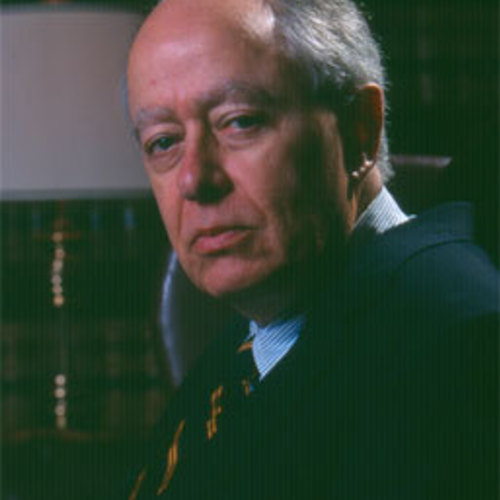
The William J. and Dorothy K. O'Neill Chair in Law Emeritus
Email: blakey.1@nd.edu
Staff Assistant: Debbie Sumption
Professor G. Robert Blakey, the nation's foremost authority on the Racketeer Influenced and Corrupt Organization Act (RICO), has served on the Notre Dame Law School faculty for more than 30 years. He teaches in the areas of criminal law and procedure, federal criminal law and procedure, terrorism, and jurisprudence. Blakey's extensive legislative drafting experience resulted in the passage of the Crime Control Act of 1973, the Omnibus Crime Control Act of 1970 and the Organized Crime Control Act of 1970, Title IX of which is known as RICO. He has been personally involved in drafting and implementing RICO-type legislation in 22 of the more than 30 states that have enacted racketeering laws. He frequently argues in or consults on cases involving RICO statutes at both the federal and state levels, including several cases before the United States Supreme Court. Blakey has considerable expertise in federal and state wiretapping statutes as well. He helped draft and secure passage of Title III on wiretapping of the federal 1968 Crime Control Act, and has been personally involved in drafting and implementing wiretapping legislation in 39 of the 43 states that have enacted such laws. Blakey has extensively investigated the assassinations of President John F. Kennedy and Dr. Martin Luther King Jr. He served as chief counsel and staff director to the U.S. House Select Committee on Assassinations from 1977 to 1979, and helped to draft the President John F. Kennedy Assassination Records Collection Act of 1992. Blakey gave remarks at the 2012 Law School Hooding/Diploma Commencement Ceremony on May 19, 2012. Blakey received Emeritus status in December 2012.
Courses Taught
- LAW60302, Criminal Law
- LAW70359, Constitutional Criminal Procedure
- LAW70362, Federal Criminal Law
- LAW70366, Federal Criminal Procedure
- LAW70434, Anti-Terrorism & Criminal Enforcement
- LAW70815, Jurisprudence
Scholarship
Books
- The Plot to Kill the President, with R. Billings (Times Books 1981), reprinted as Fatal Hour:The Assassination of President Kennedy by Organized Crime (Berkley 1992).
- Organized Crime in the United States: A Review of The Public Record on Organized Crime (NILE 1982).
- The Development of the Law of Gambling: 1776-1976 (NILE 1978).
- Racket Bureaus: Investigation and Prosecution of Organized Crime, with R. Goldstock and C. Rogovin (NILE 1978).
Segments
- Racketeer Influenced and Corrupt Organization Act (RICO), in The Encyclopedia of the United States Congress, vol. 3, 1659 (1995).
- Warren Commission, in The Encyclopedia of the American Presidency, vol. 4, 1590 (1994).
- Definition of Organized Crime in Statutes and Law Enforcement Administration, in The Impact: Organized Crime Today, Report of the President’s Commission on Organized Crime 511 (1986).
Articles
- Time-Bars: RICO-Criminal and Civil-Federal and State, 88 N.D. L. Rev. 1581-1783 (2013).
- Book Review, Harold H. Bruff, Bad Advice: Bush'€™s Lawyers in the War on Terrorism (Kansas University Press 2009), forthcoming, Review Of Politics.
- In Memoriam Professor Michael Goldsmith, forthcoming BYU Law Review
- RICO: The Genesis of an Idea, 9 Trends in Organized Crime 8-34 (2006).
- Threats, Free Speech, and the Jurisprudence of the Federal Criminal Law, 2002 Brigham Young University L. Rev. 829
- Of Characterization and Other Matters: Thoughts about Multiple Damages, 60 Law and Contemporary Problems 101 (1998).
- Reflections on Reves v. Ernst & Young: Its Meaning and Impact on Substantive, Accessory, Aiding, Abetting and Conspiracy Liability Under RICO, with Kevin P. Roddy, 33 American Criminal Law Review 1345 (Special Edition 1996).
- Federal Criminal Law: The Need, Not for Revised Constitutional Theory or New Congressional Statutes, But the Exercise of Responsible Prosecutive Discretion, 46 Hastings Law Journal 1175 (1995).
- An Analysis of the Myths that Bolster Efforts to Rewrite RICO and the Various Proposals for Reform: 'Mother of God — is this the end of RICO?' with T. Perry, 43 Vanderbilt Law Review 851 (1990).
- Equitable Relief Under Civil RICO: Reflections on Religious Technology Center v. Wollersheim; Will Civil RICO be Effective Only Against White-Collar Crime? with S. Cessar, 62 Notre Dame Law Review 526 (1987).
- Gaming, Lotteries, and Wagering: The Pre-Revolutionary Roots of the Law of Gambling, 16 Rutgers Law Journal 211 (1985).
- The RICO Civil Fraud Action in Context: Reflections on Bennett v. Berg, 58 Notre Dame Law Review 237 (1982).
- Racketeer Influenced and Corrupt Organizations (RICO): Basic Concepts — Criminal and Civil Remedies, with B. Gettings, 53 Temple Law Quarterly 1009 (1980).
- The Development of the Federal Law of Gambling, with H. Kurland, 63 Cornell Law Review 923 (1978).
- Criminal Redistribution of Stolen Property: The Need for Law Reform, with M. Goldsmith, 74 Michigan Law Review 1511 (1976).
- The Rule of Announcement and Unlawful Entry: Miller v. United States and Ker v. California, 112 University of Pennsylvania Law Review 499 (1964).
Reports
- Report of the United States Delegation, History of Organized Crime and the Success or Failure of Public Measures to Control It, in Proceedings of The First Session of the International Form on Crime and Criminal Law in the Global Era (Beijing, China, October 24-26, 2009) (with others).
- Standards Relating to Electronic Surveillance, American Bar Association Project, Minimum Standards in Criminal Justice (ABA Advisory Commission on the Police Function 1968 (tentative draft), 1972 (approved draft)).
- Aspects of the Evidence Gathering Process in Organized Crime Cases, in President’s Commission on Law Enforcement and Administration of Justice, Task Force Report: Organized Crime, at 80 (1967).
- Aspects of the Evidence Gathering Process in Organized Crime Cases, in President'€™s Commission on Law Enforcement and Administration of Justice, Task Force Report: Organized Crime, at 80 (1967).
Areas of Expertise
- Constitutional Civil Procedure
- Criminal Law & Procedure
- Electronic Privacy
- Federal Criminal Law & Procedure
- Jurisprudence
- National Security Law
- Organized Crime
- RICO
- White Collar Crime