Notre Dame Law School holds fourth annual interfaith dinner in observance of Easter, Ramadan, Passover, and Ridván
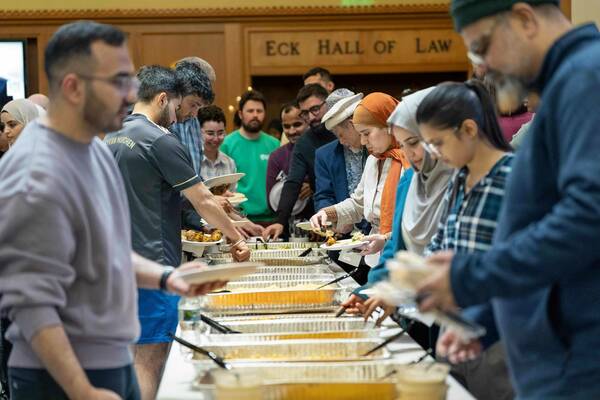
On March 28, faculty, staff, and undergraduate and graduate students from across the University of Notre Dame, as well as members of the larger South Bend community, gathered in Eck Commons at Notre Dame Law School to share a meal in observance of the Muslim holy month of Ramadan, the Jewish Passover, Easter, and the Bahá'í festival of Ridván. Now in its fourth year, the Law School interfaith dinner was sponsored by the Notre Dame Law School Office of Dignity, Solidarity, and Subsidiarity; the Lindsay and Matt Moroun Religious Liberty Clinic; the Middle Eastern Law Students Association, the Ansari Institute for Global Engagement with Religion; the Saint Thomas More Society; the Christian Legal Society; Notre Dame Campus Ministry; the Arabic Club of Notre Dame; the Notre Dame Muslim Student Association; and the Notre Dame Office of Mission Engagement and Church Affairs.
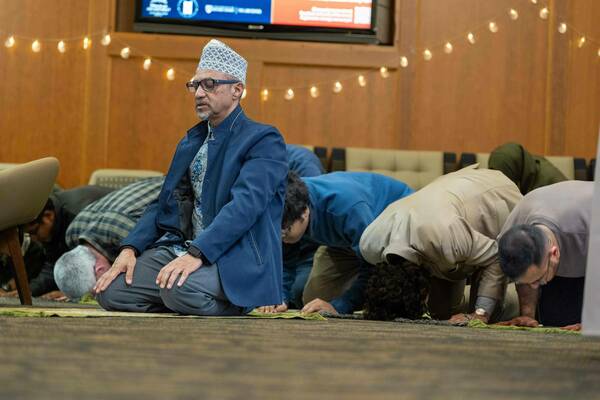
At the start of the event, Dean G. Marcus Cole, Joseph A. Matson Dean and Professor of Law, delivered opening remarks on behalf of the Law School. He welcomed everyone and highlighted Notre Dame as a place where people of all faiths are respected and valued. Dr. Rashied Omar, associate teaching professor of Islamic Studies and Peacebuilding at the Keough School’s Kroc Institute for International Peace Studies, explained the significance of the Islamic call to prayer to mark the breaking of the fast after sunset. During this time, Muslim attendees observing Ramadan broke their fast and convened together to complete their evening prayers before sharing a communal meal with the rest of the attendees. Dinner featured matzo and halal food from the Port of Peri Peri.
“Tonight, we are not only celebrating our diversity of faiths. We are celebrating our unity of purpose, love, justice, peace, and renewal. These are values that speak many languages and wear many names, but they call us all to something higher, together,” said Max Gaston, director of dignity, solidarity, and subsidiarity at the Law School.
As attendees shared a meal, several distinguished speakers reflected on their respective faith traditions—Easter, Ramadan, Passover, and Ridván—and the significance of this sacred season. They highlighted themes of renewal, self-reflection, and service that transcend religious boundaries.
Father Aaron Michka, C.S.C., assistant professor in the department of anthropology, spoke about the meaning of Easter, sharing a message of hope and emphasizing that Easter represents new life and spiritual renewal. He also encouraged attendees to act in loving service to others—a core tenet of Catholic Social Teaching that extends across faith traditions.
Dr. Omar expanded on the meaning of Ramadan, describing it as a journey of inner transformation that requires deep self-reflection on one’s character and actions. “It is a month-long exercise to conscientize us and to foster empathy, care, and concern for the poor and marginalized,” he said. He also recognized the University of Notre Dame as the “premier Catholic university where Muslims can pray and feel free to practice their faith.”
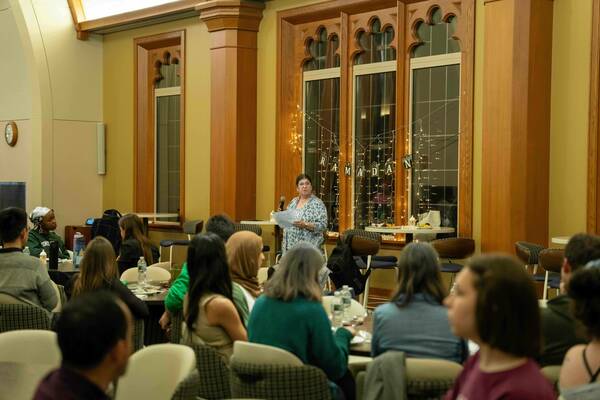
Rabbi Shoshana Feferman of Temple Israel in Valparaiso, Indiana, spoke about Passover, recounting the Exodus and the deliverance of the Jewish people from Egypt. She explored the spiritual significance of renewal and self-examination, likening it to the “spring cleaning” of the soul. “It is a time to recognize God for our good fortune in life and to thank God for the blessings of freedom He bestowed on us,” she said.
To talk about Ridván, Dr. Robert Stockman, a distinguished religious studies scholar and member of the Bahá'í faith, served as the final speaker. He described Ridván as the most sacred festival in the Bahá'í faith, a twelve-day celebration that takes place from late April to early May. He expressed gratitude for the event’s role in fostering interfaith dialogue and cooperation, strengthening bonds among different religious communities.
Gaston delivered the closing remarks, reflecting on the importance of celebrating both the shared values that united the attendees as well as their unique faith traditions. “What bonds us all together is that we believe in something greater than ourselves,” he said.
The Law School’s interfaith dinner has become a cherished annual tradition, bringing together students, faculty, and staff from across the University of Notre Dame, along with members of the South Bend community, for an evening of food, fellowship, and faith.