Notre Dame Law School Global Human Rights Clinic participates in advisory opinion proceedings on democracy and human rights before the Inter-American Court of Human Rights in Brasília
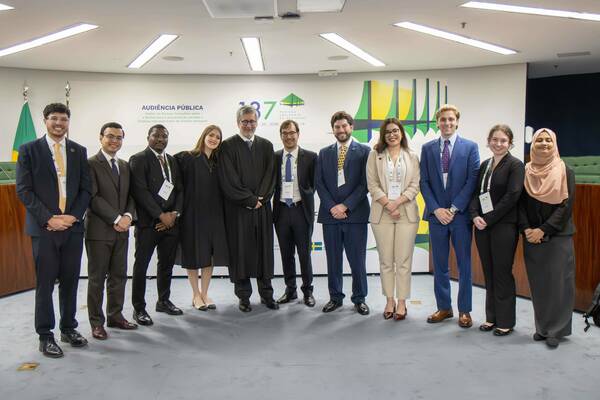
The Inter-American Court of Human Rights convened a public hearing in Brasília, Brazil, as part of its advisory opinion proceedings on Democracy and Human Rights. The request of the State of Guatemala for an advisory opinion addresses the scope of States’ obligations to protect and uphold democratic governance under international human rights law.
The Notre Dame Law School Global Human Rights Clinic’s Summer and Fall 2025, and Spring 2026 J.D., LL.M., and J.S.D. interns, led by Faisal Yamil Meneses, senior research associate, under the expert guidance and academic supervision of Professor Diane Desierto, together with Notre Dame Law School faculty members, submitted an expert brief to the Court and participated in the oral proceedings, contributing to the broader legal debate on the relationship between democracy and human rights, as well as to the development of normative standards in the Inter-American system.
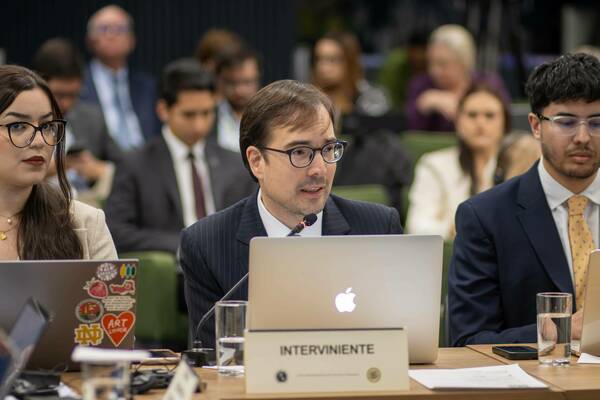
Representing the Clinic in Brasília was Associate Professor of Law Francisco J. Urbina, Human Rights LL.M. student Roselis Díaz De Freitas, and J.S.D. candidate Nicolás Buitrago Rey, who presented the Clinic’s arguments before the Court with the support of a delegation including legal fellow Josemaría Rodríguez, and students, Rasha Hifzul Rahman, Zolile Shude, Carlos Chinchilla, Christian Mikala-Ofori, Rachel Cooper, and Daniel Mooney. Their intervention demonstrated—through both empirical evidence and legal analysis—the emergence of a right to democracy in the Americas, one that is intrinsically grounded in international human rights law.
The Clinic’s intervention emphasizes the evolving recognition of democracy as a principle with legal significance in international law, as well as the consolidation of minimum democratic standards reflected in regional instruments, jurisprudence, and State practice. It further examines the legal consequences of democratic erosion and argues for the necessity of institutional responses and reparative measures when such minimum standards are breached.
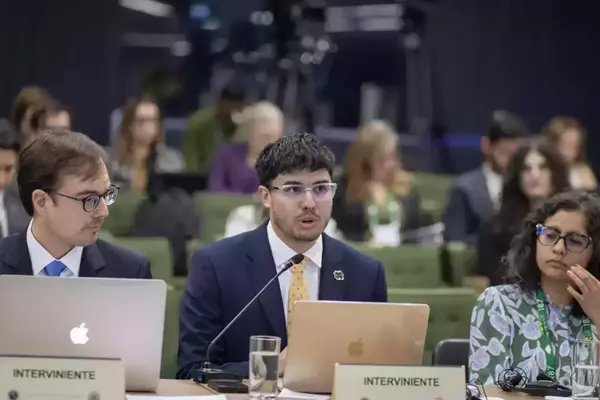
The Global Human Rights Clinic faculty director, Professor Desierto, highlighted the significance of the moment, noting the exceptional performance of the Clinic’s students, who engaged on equal footing with leading international experts during the hearing. The intervention represents the culmination of sustained academic and clinical work, bringing together legal theory, empirical research, and advocacy in a concrete contribution to the advancement of democracy and human rights in the region.
This participation builds on the Clinic’s continued engagement with advisory opinion proceedings before the Inter-American Court of Human Rights, where it contributes expert analysis on emerging issues at the intersection of international law, institutional design, and human rights protection. As reflected in prior proceedings, these hearings provide a uniquely inclusive forum for States, international organizations, civil society, and academic institutions to shape the development of international legal standards.
Through its work, the Global Human Rights Clinic seeks to support the development of legal frameworks that ensure the effective protection of human rights and reinforce democratic governance across the Americas.
The Global Human Rights Clinic is led by Professor Diane Desierto, faculty director of the Global Human Rights Clinic and co-director of the Notre Dame Reparations Design and Compliance Lab, which she co-directs with Professor Aníbal Pérez-Liñán.