Notre Dame Law Graduate Kyung Mo Kang ’26 J.S.D. Examines Accountability for Human Rights Violations in North Korea

For Kyung Mo Kang, the pursuit of justice in North Korea has become the defining focus of his time at Notre Dame Law School. Now a graduate of the Doctor of Juridical Science (J.S.D.) program, his research confronts one of international law’s most difficult questions: how to hold perpetrators of mass human rights abuses accountable.
Kang’s dissertation, titled “Transitional Justice Mechanism for Human Rights Violations: A Tribunal Model for Criminal Accountability in North Korea,” focuses on international criminal accountability for human rights violations from the perspective of transitional justice. He studies how legal institutions might respond to crimes against humanity, genocide, and war crimes committed by North Korean authorities. His work examines the International Criminal Court, ad hoc tribunals, and hybrid tribunals. He also asks which model could best support democratic governance and the rule of law in North Korea.

A major part of Kang’s research draws on in-depth interviews with 50 North Korean escapees. Their perspectives help shape his analysis of accountability. He examines how they identify perpetrators, what they hope justice will look like, and how accountability might contribute to democratic transition in North Korea.
Kang completed his dissertation under the guidance of Professor Diane Desierto. Reflecting on his time at Notre Dame, Kang points to his conversations with faculty as one of the most meaningful parts of his experience.
“I enjoyed every time I talked and discussed with professors, covering not only my own research but also their research interests and current issues,” Kang said. “Every time, I received valuable insights and suggestions, which deepened my research.”
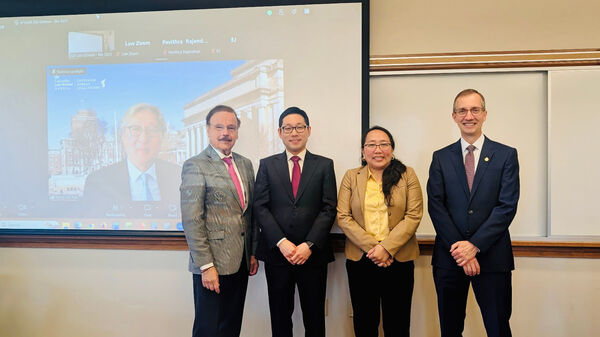
His dissertation defense took place on Tuesday, April 14, and included an assessment of his research, methodologies, and findings, followed by a question-and-answer session. The defense committee included Professor Bruce Huber, chair; Professor Diane Desierto, his advisor; Professor Jimmy Gurulé; and Professor Jeong-Ho Roh, director of the Center for Korean Legal Studies, senior research scholar, and lecturer in law at Columbia University.
Kang’s scholarship has also received recognition beyond Notre Dame. This fall, he has been invited to deliver his inaugural guest lecture at the Center for Korean Studies at Columbia Law School.
Beyond his dissertation, Kang has also been part of Notre Dame’s broader intellectual community. He has been associated with the Kellogg Institute for International Studies and has attended events and lectures offered by the Liu Institute for Asia and Asian Studies and the Klau Institute for Civil & Human Rights. Those experiences helped broaden the context for his work and deepened his engagement with questions of law, justice, and political change.
After graduation, Kang plans to continue his research on localized accountability mechanisms. He also hopes to pursue a career in research and to become involved in international criminal trials.
For Kang, being a “different kind of lawyer” means thinking beyond immediate results. It means reflecting on what legal work contributes and how it shapes the future. “A ‘different kind of lawyer’ is a lawyer who constantly reflects on what and how their practice of law contributes,” Kang said. “I think that a ‘different kind of lawyer’ is one who looks beyond immediate problems and immediate results, contemplating the essence of the issues as well as the long-term impact and ripple effects that their work will generate.”
Kang’s scholarship reflects the spirit of Notre Dame’s J.S.D. program: rigorous, globally engaged, and rooted in a deep commitment to human dignity and justice. In studying accountability for abuses in North Korea, he has taken on one of the hardest questions in international law and brought both care and clarity to the task.