Notre Dame Exoneration Justice Clinic continues annual summer internship program with students from Notre Dame, St. Olaf College, Kenya, and Mexico

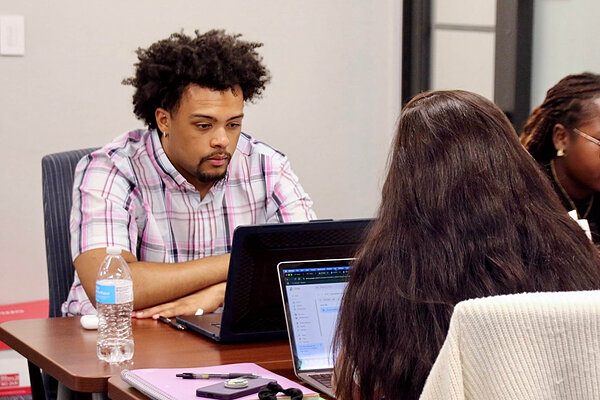
This summer, the Notre Dame Exoneration Justice Clinic (EJC) welcomed a diverse cohort of 14 student interns from the University of Notre Dame, St. Olaf College, Strathmore Law School in Nairobi, Kenya, and the National Autonomous University of Mexico (UNAM) in Mexico City, Mexico. The interns worked primarily on intake cases, allowing them to review several requests for legal representation and make recommendations on whether to accept or reject cases based on a rigorous screening process. In addition, the interns were assigned to assist in ongoing EJC cases, providing them with a comprehensive understanding of the overall process of building a case.
This summer’s cohort of EJC interns included third-year Notre Dame Law School student Zoë Bonnichsen and second-year law students, Aaron Qiao, Maggie Feighery, and Jack Puricelli; undergraduate Notre Dame students, Victor Kaminski, Caroline Petrikas, and Marco Gonzalez; undergraduate St. Olaf College students, Alex Hollie, Emma Linder, and Sarah Degand; Strathmore Law School exchange students, Anisa Ali and Gina Mulaku, from Nairobi, Kenya; and UNAM exchange students, Diana Bolaños Cuevas and Griselda Santos Garnica, from Mexico City, Mexico.
“Our obligation to our clients does not end at the end of the academic year. We have an obligation to our clients every month of the year,” said Professor Jimmy Gurulé, founder and director of Notre Dame Law School’s Exoneration Justice Clinic. He added that the annual summer internship program provides "intensified participation for the students.”
Each year, the program includes Notre Dame Law students who continue their involvement in the EJC during the academic year.

One of those students, 2L Maggie Feighery, reflected on the hands-on experience the summer program provides. “The EJC is unique in that we get outside of the classroom setting of hypotheticals and distant case studies and we are working with real clients whose lives are affected by the work we’re doing in this office every day,” said Feighery.
This summer's cohort also included students from Strathmore Law School in Kenya and UNAM in Mexico. "This is an opportunity for the EJC to train foreign students,” said Gurulé. “We are taking our experience and we're sharing it with foreign students. The hope would be that they take the education they receive and enhance their efforts back at their home site."
Gina Mulaku, one of the two exchange students from Strathmore Law School who participated in the program, reflected on the practical experience she gained through the EJC. “The activities that we take part in at the Exoneration Justice Clinic at Notre Dame Law School are very practical, and so I’m able to learn and see how investigations are carried out and how a real setting trial is done in the American law system,” said Mulaku. “I believe this will help me further my law studies in that now, I’m able to make a good decision on what I want to do in the future.”
Mulaku added, “Also, I am learning a lot about what it means to be an ethical lawyer, or what it means to do proper investigations in a case, what it means to follow the law and, at the end, always promote access to justice to everyone. I believe that that will enable me to be a great lawyer in the future.”

Griselda Carina Santos Garnica, one of the two exchange students from UNAM who participated in the program, said, “The difference is that in the classroom we learn all of the theoretical and written aspects, while in the clinic, we have the opportunity to put all of that knowledge into practice. I believe it is a wonderful way to contribute and to help people who need our assistance.”
The UNAM students worked on cases involving Mexican nationals wrongfully convicted of a crime they did not commit. Their work was conducted through the Program for the Defense of Mexican Nationals (PDM), a dimension of the EJC that provides legal assistance to Mexican nationals facing criminal charges or wrongful convictions.
The interns gained hands-on experience throughout the summer through their work on a variety of EJC cases and projects.
The main responsibility of the interns was to assist the clinic in deciding which cases to accept for legal representation, primarily by reviewing requests that the EJC received from Indiana prison inmates. The interns evaluated the inmates’ claims of innocence to determine their credibility. They assessed whether or not the EJC could prove the inmates’ actual innocence and explored potential avenues that the clinic could pursue to prove their innocence. To conduct their preliminary evaluations, the interns used a comprehensive intake process, developed by the EJC, that is guided by about a dozen objective factors and criteria. After conducting their evaluations, the interns reviewed correspondence, a detailed questionnaire from each inmate, and trial transcripts to look for evidence of wrongful conviction.

The interns then prepared detailed recommendation memos for Gurulé and the clinic’s attorneys to review, allowing them to enhance their legal writing skills. The clinic also held intake meetings, where the interns delivered an oral presentation to defend their recommendation.
In addition, the students attended a lunch seminar with Rachel Schneider '23 J.D., a former EJC alum who is now a prosecutor. They also met with EJC client Iris Seabolt, attended a murder trial in St. Joseph County court, and made prison visits to meet with clients. The students who worked on PDM cases got to visit the Mexican consulate in Chicago, as well.
The Notre Dame Exoneration Justice Clinic has received approximately 850 requests for legal representation since its opening in the fall of 2020. The EJC accepts around 3 percent of requests. Currently, the clinic is actively engaged in approximately 17 cases.
Learn more about Notre Dame Exoneration Justice Clinic at exoneration.nd.edu.
EJC interns reflect on their experiences during the summer program
Interns reflected on their experiences working with the EJC and what they learned from the clinic's hands-on approach to legal education.
Aaron Qiao
2L at Notre Dame Law School and Notre Dame Exoneration Justice Clinic Student
“What I would like to tell a prospective student about the EJC summer program is that if you want your mission in the legal field to be about justice and about doing right, and if you are interested in the criminal field, this is one of the best opportunities to do for your first summer, just because you have a very well-guided understanding by the faculty and the staff here to get a full, comprehensive understanding of the criminal legal system.”
Alex Hollie
St. Olaf College Undergraduate Student
“This experience is different from a traditional classroom setting because we’re directly involved in people’s lives and if they’ll be able to retain post-conviction relief.”
Caroline Petrikas
University of Notre Dame Undergraduate Student
“Participating in the EJC summer internship is exposing me to a new area and helping me move beyond just the theoretical in classrooms to the actual, tangible challenges in our political system. As a Political Science major, I think we often talk about a lot of the discriminatory or prejudice issues with the system, but I think it’s much different to learn about those than it is to actually see how they’re being addressed in cases and the challenges that everybody is facing. This experience is helping me understand them beyond the classroom in a more physical sense.”
“I just want to thank Professor Steven Landis in the Political Science department and Professor Gurulé for all of their work in setting up this partnership and for extending the opportunity to me. I am very grateful for this opportunity. I want to thank Professor Gurulé, as without his leadership and guidance, the clinic would not be here today.”

Diana Estefanía Bolaños Cuevas
National Autonomous University of Mexico (UNAM) Exchange Student
“First, I would like to thank Professor Jimmy Gurulé for this experience, and also Dr. Imer Flores from UNAM for trusting us with this project. It is a great initiative for both universities. I would also like to thank my family for their support and for helping me achieve yet another meaningful experience.”
“I believe the experience in the EJC will help me tremendously, not only professionally but also personally and academically, since I am able to compare different legal systems and interact with many peers who share similar professional aspirations.”
Griselda Carina Santos Garnica
National Autonomous University of Mexico (UNAM) Exchange Student
“I would like to thank UNAM for creating these partnerships with other universities. I believe they are greatly needed, at least in our country. At Notre Dame, I would like to thank Professor Jimmy Gurulé for choosing UNAM and, in this case, for selecting me to be part of this project. I would also like to thank Joshua Kuiper. He has truly been a tremendous help. At Notre Dame, he is always very attentive to us as exchange students. They have helped us tremendously throughout this entire clinical experience.”

Jack Puricelli
2L at Notre Dame Law School and Notre Dame Exoneration Justice Clinic Student
“I’m a Catholic. I’m a Christian. I strongly believe that the law should be a tool of mercy. I came to law school because I knew law was a vocation for me, so working in the EJC summer internship program furthers that goal of learning how to use the law as a tool of justice and a tool of mercy.”
Marco Gonzalez
University of Notre Dame Undergraduate Student
“The EJC summer internship program is going to prepare me for a future in law because I’m doing a lot of intake work, reading through a lot of cases, and going through a lot of different aspects of the law that are really helping me understand the criminal justice system. I would tell a prospective EJC student that this work is awesome because it’s fulfilling and interesting, you learn a lot, and you actually get to help real people along the way.”