Class of 2026 Commencement Feature: Morgan Hall

From the time she was in third grade, Morgan Hall knew she wanted to be a lawyer.
Years later, while looking through an old notebook, Morgan found she had written that she wanted specifically to become a criminal defense attorney. “Third graders don’t usually talk about being criminal defense attorneys,” she said with a laugh. Even then, the instinct behind that goal was already taking shape—guided by her mother’s encouragement to look beyond immediate assumptions.
“She always taught me to see the other side,” Morgan said. “Whether it was on the playground or just in life, she would say, ‘What were they going through? Why were they acting that way? How do you think they felt?’”
That mindset stayed with Morgan. She was drawn not only to argument and advocacy, but also to the idea that every person has a deeper story. “This isn’t just a bad guy,” she said. “There’s a lot more there.”

A Colorado native, Morgan took a deliberate path to law school, beginning at Bowdoin College, where she played collegiate tennis, before transferring to the University of Michigan. While law school was never in doubt, the specific school she would attend was less certain.
Although she considered several schools, Notre Dame lingered in the background. When it came time to decide, Morgan turned to faith.
“I was like, ‘God, I’m going to need a sign if I’m supposed to be at Notre Dame Law School,’” she said.
In her prayer and to her family, she named a scholarship amount that would make her decision clear. Within 24 hours, she received a scholarship offer exceeding that amount—her sign that she was supposed to be at Notre Dame—and within days, she was on campus to visit and enroll. What began as a moment of discernment would later become a deeper transformation in her faith.
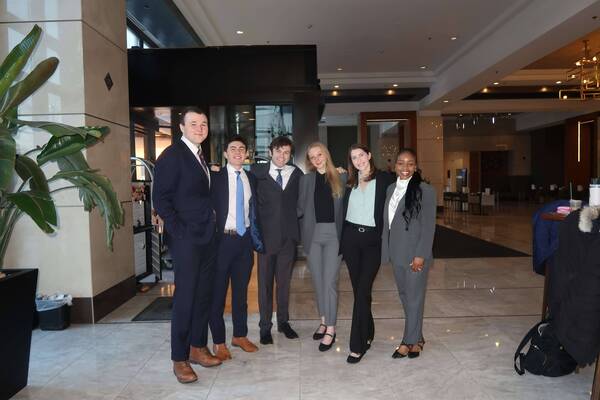
During her time at Notre Dame Law School, two experiences proved especially formative: mock trial and the Notre Dame Exoneration Justice Clinic.
Morgan quickly discovered she felt most at home in the courtroom. After competing in a 1L moot court tournament, she joined mock trial and found a new outlet for advocacy.
“I absolutely fell in love during the competitions,” she said. “Being in the courtroom was one of the most fun experiences I will ever have.”

At the same time, her work with the Notre Dame Exoneration Project and the Exoneration Justice Clinic grounded her sense of vocation in service. Morgan served as a 1L representative, later became president of the student organization, and joined the clinic as a 2L.
“I knew that my law vocation was supposed to be helping people, and it was supposed to be helping the community,” she said. She saw firsthand how much was at stake. “You’re actually working as an advocate, working alongside someone on a journey,” she said.
Those experiences also changed the direction of her career.
Morgan had always imagined herself on the defense side. But through her clinic work and internships, she saw how devastating the consequences can be when prosecutors get it wrong. Instead of pushing her away from prosecution, that awareness drew her toward it.
“I realized that I could make a bigger impact for myself by being a prosecutor,” Morgan said.

Seeing the flaws in the system made her more determined to enter it with care and integrity. “I realized that that was something I wanted to do—the burden I wanted to carry by being a prosecutor.”
Her summer experiences deepened that perspective. Morgan worked with the Capital Habeas Unit for the Federal Defender for the Middle District of Florida in Tampa, working on death penalty cases and visiting death row, and at a civil rights firm, Loevy & Loevy in Chicago, focusing on Section 1983 cases, including matters involving exonerees.
Back on campus, Morgan found important mentorship as well. She credits her mock trial coach, Joel Williams, as an influential figure. “He’s served as a really big mentor in coaching me to be the best trial attorney that I can be,” she said.
After graduation, Morgan will join the Elkhart County Prosecutor’s Office. Her path reflects not a departure from her original goals, but a deepening of them. The little girl who wanted to become a criminal defense attorney because she believed there was always another side to the story is still guided by that same conviction—now shaping how she hopes to pursue justice from a different seat in the courtroom.
For Morgan, that calling became intertwined with her spiritual life at Notre Dame. Raised Protestant, she converted to Catholicism during her first year of law school. “I was drawn into that Catholic spirit,” she said. That sense of purpose now informs the kind of lawyer she hopes to become.
“Being a ‘different kind of lawyer,’” Morgan said, “means using the skills given to you to make an impact for people who are not given the same privileges or the same opportunity to have this education.”