Faculty Profile: Professor Mary Ellen O’Connell, Globally Influential Scholar of International Law and Peace
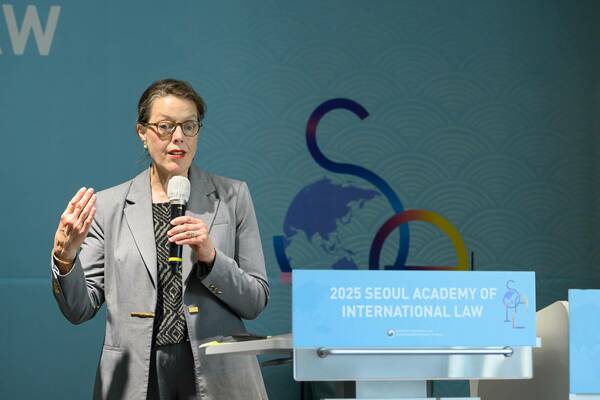
Professor Mary Ellen O’Connell holds the Robert & Marion Short Chair in Law at Notre Dame Law School and is also Professor of International Peace Studies in the University’s Kroc Institute for International Peace Studies (Keough School of Global Affairs Concurrent Professor). At Notre Dame Law School, she teaches International Law, International Art and Cultural Heritage Law, International Law and the Use of Force, International Dispute Resolution, and the law of Contracts. A renowned authority on international law, her career spans academia, private practice, and public service. Her expertise ranges from the law regulating resort to armed conflict to developments in military use of artificial intelligence to natural law theory.
Professor O’Connell has twice been a visitor at the University of Chicago Law School and Johns Hopkins University School of Advanced International Studies in Bologna, Italy. She has been named to prestigious positions at the Center of Theological Inquiry (Princeton), the Norwegian Nobel Institute, the University of St. Andrews (Scotland), and the Korean National Diplomatic Academy. She chaired the International Law Association’s Committee on the Use of Force for five years and was a vice president of the American Society of International Law. She has taught for the United States Department of Defense as a professional military educator and was a lawyer in private practice handling a wide range of international law matters.
O’Connell’s lifelong commitment to peace and international law was born early. She was just five years old when Pope St. John XXIII issued his message of peace in the encyclical Pacem in Terris. It became a foundational influence in shaping O’Connell’s sense of vocation and commitment to international law. “Pope John wrote about Christ’s teaching of peace, and I soon discerned that teaching the law of peace could direct my life and work,” she recalled. “I’ve been able to fulfill that vocation at Notre Dame in a way that I could not at any other law school.”
By the age of ten, she knew she wanted to become a lawyer. By fifteen, she had decided to dedicate her life to international law. Coming from a long line of teachers, O’Connell was attracted to a career that combined teaching, scholarship, and law that prohibits the use of force and promotes human rights, the environment, and the peaceful settlement of disputes.
She sees education as a key to building respect for and compliance with this law. For education to have this beneficial impact it must concern authentic law. Since the end of the Cold War, law is increasingly interpreted to support policy rather than the actual content. To reverse this trend, she believes law professors need to recognize how far we drifted from accurate interpretation.
“Many can no longer see the way back,” she observed. This belief drives her passion for teaching the next generation of lawyers and judges. Her goal is to equip students not only with legal knowledge but also with the courage to engage with the law honestly.
Professor Mary Ellen O’Connell is a globally recognized authority on international law whose distinguished career reflects an unwavering commitment to peace on a global scale. A prolific scholar and dynamic speaker, she is frequently invited to share her expertise on the world stage, and her insights are regularly featured in major news outlets. Her influential body of work spans numerous books, articles, and legal commentaries that have shaped international legal thought and policy. Explore a selection of O’Connell’s publications below to learn more about her extraordinary contributions to the legal field—both at Notre Dame and around the world.
What Remains of Law Against War
In her 2024 Georgetown Law Journal article, What Remains of Law Against War, O’Connell argues that the prohibition on the use of armed force—codified in the United Nations Charter and grounded in natural law—cannot disappear, but it has been dangerously disregarded.
She points to Russia’s invasions of Ukraine in 2014 and 2022, along with ongoing conflicts in the Middle East and Africa, as examples of how the law against war has been violated far more seriously since the end of the Cold War than in the previous five decades after the adoption of the 1945 UN Charter. Yet, as O’Connell emphasized, “International law didn’t disappear. It was disrespected by powerful states and by legal scholars who moved away from foundational truths apparently for reasons of political expediency.”
One major factor in this erosion, she explains, has been the rise of a concept, the “Rules-Based International Order” (RBIO), a system promoted by the United States and its allies after the Cold War. The RBIO allows certain states to exercise the use of force with minimal legal justification, while others are held to the higher standard of authentic law. This double-standard defies the principle of sovereign equality. “Certain governments want credit for being law-abiding, while not being constrained by law,” O’Connell said. “So they reinterpret the rules to suit their interests. That combination has led to widespread death in armed conflict and a negative impact on the rule of law itself.”
She also points to shifting intellectual trends within the academia as a cause of decline in respect for law against war. By the end of the Cold War, few international law professors included natural law theory in their assessment of legal principles. Natural law incorporates transcendent sources of knowledge to support the enduring quality of the law against war. Most professors use the alternative to natural law theory, positivism, which is vulnerable to manipulation for political ends. Restoring knowledge of the natural law foundations of the UN Charter will aid in restoring understanding of what its principles require and the duty to comply with them. “If we start teaching the true meaning of the Charter again, its grounding in ancient law, we could see swift and extensive positive impacts,” she added.
In an era of global uncertainty, including the growing influence of artificial intelligence, O’Connell contends that recommitting to the enduring natural law against war is not only possible but necessary for orienting AI and other means and methods to the achievement of peace.
The Nicaragua Case, Preserving World Peace and the World Court
O’Connell examines one of the most significant judgments of the International Court of Justice (ICJ) in her book chapter, The Nicaragua Case: Preserving World Peace and the World Court, published in International Law Stories (Foundation Press, 2d ed. 2025). All UN members are parties to the treaty establishing the ICJ, which is the chief judicial organ of the United Nations. The court's role is to resolve international disputes through the application of international law. The prominence and success the court enjoys today can be traced from the lawsuit brought by a small Central American state against the U.S. Nicaragua won its case against the U.S. for the unlawful use of force in violation of the UN Charter.
She highlights that the 1986 case was a watershed moment. The U.S. put political pressure on the court to decline to take the case. When it resisted the pressure and handed Nicaragua a victory, the court demonstrated that law against the use of force applies to all on the basis of equality regardless of the size of a state’s military or economy. “The decision was a sensation,” O’Connell noted, “showing the world that the courtroom could provide a level playing field for the fair and effective settlement of disputes.”
The case remains the most important adjudication of the United Nations Charter, setting the standard that all states use today, including the U.S. and protecting global peace. O’Connell draws connections to other cases against militarily and economically more powerful states, such as South Africa’s legal action against Israel for violation of the Genocide Convention and the Advisory Opinion on the Obligations of States in respect of Climate Change.
For O’Connell, the Nicaragua case illustrates the ongoing importance of the International Court of Justice to the rule of law in the world.
Banning Autonomous Weapons: Legal and Ethical Mandate
In her article Banning Autonomous Weapons: Legal and Ethical Mandate (Journal of Ethics and International Affairs, 2023) O’Connell issues a clear warning that artificial intelligence is developing rapidly without regard for the international law on the use of force. When AI is used as part of a weapons system to select and kill people without human intervention, they pose serious legal and moral risks. “Target selection programs are already being used in ways that clearly violate international law,” says O’Connell.
She argues that international lawyers working with tech developers need to create the AI tools that can defend us from unbridled, offense-oriented AI. “The only way to counter offensive AI is with defensive AI that complies with international norms,” she noted.
O’Connell points to the "black box" problem as one of the most alarming features of autonomous weapons: even developers cannot fully predict how an AI system will behave once deployed. “AI models are not safe and no one knows how to reliably make them safe,” she explained. This knowledge gap, combined with the irreversible consequences of autonomous machine killing, undermines both the laws of armed conflict and the principle of human dignity.
While advocates argue that the use of LAWS is already illegal under existing international law, O’Connell contends that an express legal prohibition is still urgently needed to raise awareness and reinforce compliance.
“All that international law stands for—peace, human rights, and environmental protection—is at stake if we fail to regulate this technology,” she warned.
O’Connell is actively engaged in shaping global discussions. She has lectured on AI and international law in Vienna, at the Vatican, and in South Korea, where she was invited to teach an advanced course for the Ministry of Foreign Affairs. O'Connell has also given two high-profile lectures on AI and international law—the Inaugural Peter Wallensteen Lecture, "AI for Peace," at Uppsala University in May 2025 and the Fifth Annual Justice Stephen Breyer International Law Lecture on Autonomous Weapons at the Brookings Institute in April 2018. She is a Commissioner with the Global Commission on Responsible Use of Artificial Intelligence in the Military Domain, an initiative of the government of The Netherlands. During 2024-2025 she traveled with the Commission to South Korea, South Africa, Abu Dhabi, The Netherlands, and Washington, D.C.
The Role of Natural Law in the Rise and Decline of European International Law
O’Connell explores how natural law, once understood as central to international law and all legal theory, was deliberately pushed aside to serve European imperial interests in her book chapter, The Role of Natural Law in the Rise and Decline of European International Law (The Oxford Handbook of International Law in Europe, 2025).
The chapter reveals how the pressures of late European colonialism led to the intentional rejection of natural law and replacement with an inadequate version of positive law.
The impact of this effort was particularly damaging to the prohibition on the use of force. European international lawyers began to falsely argue that no law against war existed until the 20th century and the adoption of treaties restricting resort to force. She traces how 19th-century legal theorists replaced universal legal norms grounded in equality and human dignity with a positivist framework that supported colonial domination through a two-tiered system of “civilizational hierarchy.” The negative impact of positivism continues to plague understanding and compliance with international law. O’Connell calls for a renewed commitment to natural law, arguing that foundational principles should no longer be subject to self-serving manipulation using positive law method.
Beyond Wealth: Stories of Art, War, and Greed
In her article, Beyond Wealth: Stories of Art, War, and Greed (Alabama Law Review, 2008), O’Connell examines the global black market for stolen art and cultural heritage, revealing a troubling intersection of war, wealth, and criminal enterprise. Despite legal protections, looted art continues to flow through the hands of smugglers, cartels, and high-end collectors, often with little accountability. The mystery is why otherwise law-abiding people would ever purchase black market art.
O’Connell points to the vast looting of museums in war-torn regions and the ongoing demand among the ultra-wealthy. At the time she wrote the article, expensive art became an attractive asset for laundering money, particularly in an era where cryptocurrency makes illicit transactions harder to trace. Now, however, cryptocurrency is replacing art as the preferred means of exchange by crime organizations.
Through this work, and her Notre Dame Law course, Art and Cultural Heritage Law, O’Connell encourages students to see cultural heritage not just as property, but as a matter a universal value representing humanity’s greatest achievements.
A Different Kind of Lawyer
For Professor Mary Ellen O’Connell, being a “different kind of lawyer” means more than understanding legal rules—it requires the integrity to engage with the law in an authentic and principled way. “It’s about not being afraid to take an individual stance on the great legal questions,” she stated. “Even when it’s more popular to be part of a consensus, a lawyer’s responsibility is to follow the evidence and remain true to the law’s authentic content and purpose.”
O’Connell offers a distinctly global perspective in her teaching, shaped by her time as a Marshall Scholar in the United Kingdom and her experience teaching international law for the U.S. Department of Defense in Germany and Johns Hopkins University in Italy. But what distinguishes her most is her conviction that the law is based on our deepest moral principles, in particular, our moral commitment to peace. "The law is not a tool to promote policy; policy must promote law,” said O’Connell. This is all the more true when the law aims to protect life. Her work devoted to preventing the normalization of unlawful killing has drawn global attention, thanks in her view, to the constant support of Notre Dame. It is work that continues.