Class of 2026 Commencement Feature: Nora Ibrahim
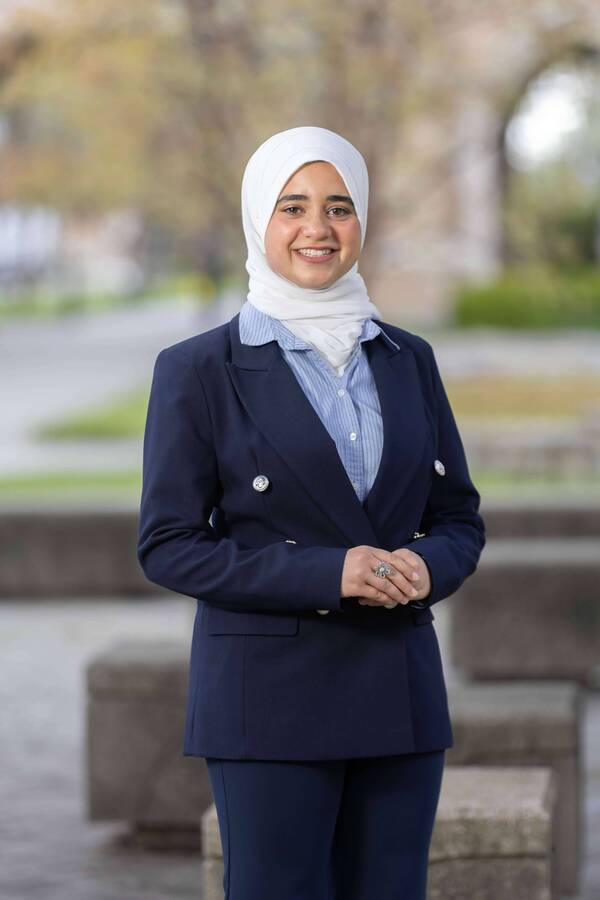
Nora Ibrahim once saw the world in black and white.
As an undergraduate biology major specializing in endocrinology, she was drawn to the clarity of science, where answers are measurable and definitive. “I like the black and white of the sciences and the absolute nature of the study. You’re either right or you’re wrong,” she said. But even then, she began pushing herself beyond that framework by minoring in visual arts to challenge how she thought. “In the arts, you’re very much in the gray zone,” she said. “You’re challenging your brain to think beyond the black and white.”
That tension—between certainty and complexity—would shape her path.
After graduating in 2019 from the University of Chicago, Nora spent four years in clinical research, including work in cardiogenomics at Northwestern University. There she studied sudden cardiac death in young patients to better understand potential genetic causes. She later transitioned to anesthesiology research, focusing on improving how patients are monitored during surgery.
The work was meaningful, and at one point Nora planned to become a cardiac surgeon. But over time, her perspective shifted as she realized the profession didn’t align with how she envisioned her future or the kind of relationships she wanted to build.
“You never go to your doctor and say that you are excited about something good happening in your life,” she said. “You go to them and you tell them, ‘fix me,’ and you don’t see them again until the next time you feel sick.”

In contrast, she saw law as a space where she could walk alongside people through both challenges and successes.
“You’re seeing your clients when they’re having personal or professional struggles, but you’re also there at the finish line, celebrating their wins with them. It’s exciting to be by their side through it all,” she said.
That realization led her to law school. When she arrived at Notre Dame, she quickly discovered that the law was far from the black-and-white system she had imagined.
“I initially thought either you’re responsible because you’ve committed whatever charge you’re accused of, or you’re not,” she said. “But then you read opinions and cases, and you realize the law functions very much in the gray.” The adjustment was challenging, but it reinforced something she had already begun to learn: the world—and the law—requires comfort with nuance. “You have to get comfortable with the gray,” she said. “You’re never just right or wrong.”
At Notre Dame, Nora found both intellectual challenge and a strong sense of community. Drawn in part by its proximity to her family in Chicago, she was equally influenced by the Law School’s collaborative culture and engaged faculty. “The professors genuinely care about you as an individual and your career,” she said. “They will give you time just because you stopped by their office to say hello.”
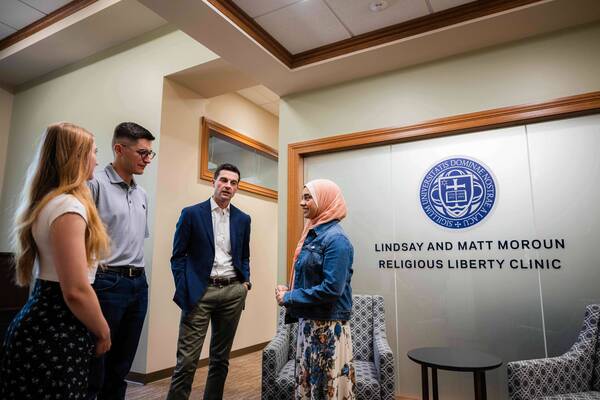
She immersed herself in that community, serving as president of the Middle Eastern Law Students Association and as a notes editor on the Journal on Emerging Technologies. She also participated in the Diverse Attorney Pipeline Program, building mentorship connections that supported her transition into the legal field.
At the same time, Nora sought out spaces where she could connect with her identity, including the Notre Dame Muslim Student Association. As a Muslim student at a Catholic law school, her experience was both unique and formative. “This was the first time I was the only visibly Muslim person in a space,” she said. “Although it was difficult at times, it was certainly a shaping experience.” Over time, that initial adjustment gave way to a deeper appreciation for the environment. “I appreciate people’s curiosity, especially when they choose to ask questions instead of relying on assumptions,” she said.
Her experience in the Lindsay and Matt Moroun Religious Liberty Clinic, working in the transactional advising section, further shaped her perspective, particularly her interest in supporting religious organizations with limited resources.
Beyond the classroom, Nora also found community as an assistant rector in Cavanaugh Hall, mentoring the undergraduate women who lived there. Her widely popular weekly program, “Tea Talks, Hot Choc, Snack Wok Wednesday,” brings students together over themed gatherings and homemade food and regularly draws a crowd of young women.
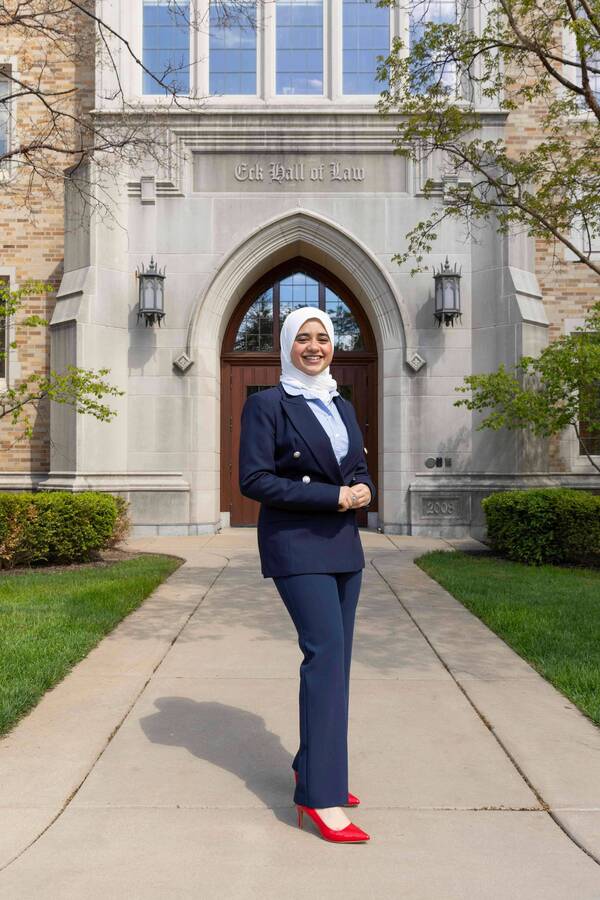
Through these experiences, Nora developed a clearer sense of what it means to be a lawyer—and the kind of lawyer she hopes to become.
After graduation, Nora will return to Chicago to begin her career as a corporate attorney at Faegre Drinker where she is drawn to the collaborative nature of the work. Nora hopes to carry forward everything she has learned—across disciplines, communities, and experiences—into her work.
“I think being a ‘different kind of lawyer’ means that you approach anybody you talk to with kindness, compassion, and understanding,” she said. “You have to take a moment to pause and just listen. The more you listen, the more likely you are to respond with compassion instead of jumping to immediate judgment.”
In a profession often defined by argument and certainty, Nora has learned to embrace something different—the space in between. In that gray, she has found not only her path, but the kind of lawyer she hopes to become.