Class of 2026 Commencement Feature: Emmett Gillen

For Emmett Gillen, the path to law school was already familiar. But even though his father and two older brothers are lawyers, for Emmett, choosing the law was never about following a script. It was about committing to a set of ideals that would define not just what he did, but why he chose the law in the first place.
Born in Ann Arbor and raised between Michigan and Florida, Emmett considers the Midwest home. His upbringing was shaped in part by a homeschooling education rooted in the classics, instilling disciplined thinking and moral reflection that would later guide his academic and professional life.
For three years in high school, Emmett had worked for a pension administrator, an experience that drew him toward finance. Then at Florida State University, he graduated in just three years with a degree in finance, later pursuing an MBA in supply chain management. Between his honors courses and his minor in free enterprise and ethics, Emmett also took courses in philosophy and international law, exposing him to new ways of thinking about the role of law.
By the time he arrived at Notre Dame Law School, Emmett had built an impressive academic résumé and envisioned a future in international transactional work. But early in his first year, something began to shift.
"Notre Dame's mission, faculty, and even its students encourage pursuing a non-traditional path in the profession,” he said. “I decided to take advantage of that and try to pursue something more personally meaningful at this stage of my life."
That realization prompted him to reconsider his priorities. As he moved through his first-year courses, he found himself drawn to criminal and constitutional law—and increasingly to the idea of service.

By the summer after his first year, Emmett had made his decision: he would pursue a career as a Judge Advocate General.
“I wanted to simplify my priorities, and JAG seemed to marry my legal interests with an overarching mission of service,” he said. “Everyone is looking for a higher ideal—love of country, love of neighbor. Those all attracted me to JAG.”
That commitment to service has shaped his time at Notre Dame. Drawn to opportunities that connect legal training with real-world impact, Emmett immersed himself in clinical work. He spent two semesters in the Special Education Clinic and another in the Veterans Law Clinic.
In the Special Education Clinic, Emmett worked with families seeking appropriate educational resources for their children—an issue that aligned with his support for school choice. “Not everyone learns the same way,” he said. “Helping individuals who have been traditionally left behind in the educational space get what they need to fully participate in society felt like a very worthwhile mission.”
Reflecting on his involvement in both clinics, he added, “On a broad level, you have veterans and you have concerned parents trying to help their children. They’re thrown into complex legal spaces and asked to navigate them on their own. The work of these clinics provides an invaluable service to people who greatly need it.”
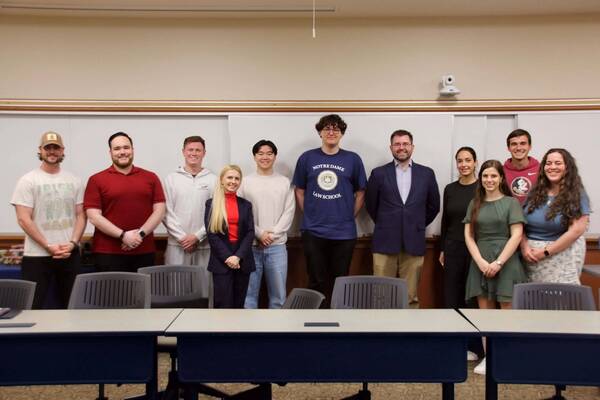
Beyond the clinics, Emmett found mentors who helped sharpen both his thinking and his sense of vocation. He points to associate clinical professor Christina Jones (now Stone) for her deep knowledge and passion for special education law, her husband, associate clinical professor Caleb Stone, for those same qualities regarding veterans law, and Professor Mary Ellen O'Connell, whose teaching on international law and ethics left a lasting impression.
"Knowing the full legal framework in which one operates, as well as the full array of ethical considerations at play in a particular situation, can only help when trying to make the right call," he said.
Emmett’s summers reinforced his interest in litigation and public service. After his first year, he worked in the Charlotte District Court with the Honorable Judge Robert J. Conrad Jr. The following summer, he served as a research assistant to Professor Jorge Barrera-Rojas, focusing on education-related issues such as private school vouchers and scholarships.
After graduation, Emmett will enter training in Quantico as part of the Marine Corps JAG program, where he will serve on active duty for at least four years. The path ahead is demanding, but for him, it reflects a deliberate choice to align his legal career with a broader sense of mission.
That vision is rooted in what it means to be a “different kind of lawyer.”
“In an increasingly technical field, it’s important that you stay grounded in the idea that you are providing a service to others with their best interests in mind and not necessarily your own,” he said. “There is a biblical calling to service. At times that might require reshaping your priorities and vision for life.”

For Emmett, the law is not simply a profession—it is a means of pursuing something greater.
“Ultimately,” he said, “it’s about serving your country, the poor, or those most in need. That does not have to be the case for every individual at every point in their professional career, but integrating one's personal beliefs with one's career as closely as possible is a worthwhile goal.”
As he prepares to carry those ideals into the work ahead, they will continue to guide the lawyer he is becoming.