Class of 2026 Commencement Feature: Diana Vallejo Ramirez

Diana Vallejo Ramirez was five years old when she immigrated from Mexico to the United States. Growing up in California as one of six children raised by a single mother, she learned early that the law was not abstract; rather, the law actively shaped her life. She observed firsthand how immigration policies could define the boundaries of possibility—shaping what families could build and pursue for their futures.
Her early exposure to the law and its intricacies sparked her desire to pursue a career dedicated to helping others. That sense of purpose deepened over time—through her studies at UCLA, where she double majored in Labor Studies and Chicano Studies, through long hours working hospitality jobs, and through her work as a case manager at KPB Immigration Law Firm in Napa. There, she helped file over 100 cases, from asylum petitions to U visas for victims of crime. She also volunteered with the Immigration Institute of the Bay Area, translating and assisting with petitions, often for farmworkers and hospitality workers.
Together, her studies and work experience did more than clarify her ambitions—they refined her sense of direction.
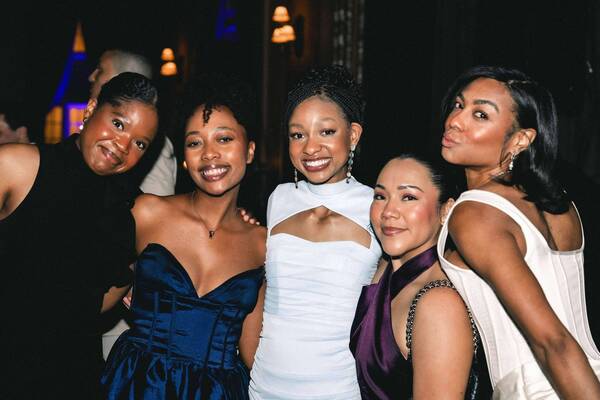
Upon admission to Notre Dame Law School, she received the James and Katherine O’Reilly Notre Dame Law School Fellowship, fully funding her legal education. At the Law School, Diana found both rigor and belonging.
“I wanted to be challenged, and Notre Dame is very rigorous in its academics,” she said. “I also liked the small classes because I had come from a huge public university.”
Diana added, “Law school was really hard, but the group of people that I found made it a really fruitful experience and made me feel like I truly belonged.”
That sense of belonging translated into purposeful action through her involvement in the Community Development Clinic, where the law became not just something to study, but a tool to build opportunities for others.
In a single semester, Diana helped incorporate a U.S.-based nonprofit affiliate for Friends of Sembrandopaz Inc., an organization dedicated to advancing peacebuilding and sustainable development among grassroots communities in Colombia’s Caribbean region. She drafted articles of incorporation, wrote bylaws, and led the organization’s first board meeting.
“That was the most fulfilling experience,” she said. “I helped Sembrandopaz become an established presence in the United States. I facilitated a way for them to get funds and still abide by tax laws.”
It was, in many ways, a meaningful act of empowerment—one that expanded access to resources and created opportunity.
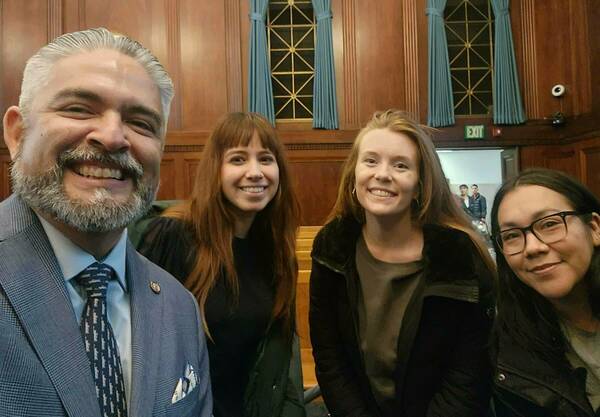
Her journey also came full circle in an unexpected place: a naturalization ceremony she attended during her Immigration Law course, taught by adjunct professor Rudy Monterrosa.
“It was a really full circle moment for me,” she said. “It was the confirmation that I was in the right place and on the path that I wanted to be on.”
For someone who had experienced the weight and complexity of immigration, witnessing others take that final step toward citizenship was not just symbolic; it was deeply personal.
Throughout her time at Notre Dame, Diana remained committed to community. She served as a 1L representative for the American Constitution Society, treasurer for First Generation Professionals, was a member of the Hispanic Law Students Association, and volunteered in Chicago to assist immigrants renewing their petitions.
“As a first-generation student, I felt lost,” she said. “But Notre Dame had a really strong support system, which is why I joined the First Generation Professionals—to give back and keep it going.”
During her law school summers, she worked as a judicial extern with the U.S. Bankruptcy Court for the Northern District of Indiana, and as a summer associate with Lippes Mathias LLP, where she discovered her interest in transactional work.

Now, as she prepares to return to Lippes Mathias LLP in Buffalo, New York, to begin her career in corporate law, Diana carries with her a vision that is both expansive and deeply rooted.
“Being a ‘different kind of lawyer’ means being who you really are,” she said, “and embracing all your skills and potential in a way that fulfills what you want to do, whether that be public interest or transactional work. Notre Dame really helps you figure out what your passions are so that you can create your own path.”
Her path has never been linear. It has been shaped by movement—across countries, across disciplines, across defining moments. But through it all, one truth remains clear:
For Diana, the law is not just a profession. It is a means of building something enduring—grounded in dignity, guided by purpose, and shaped by those determined to create new pathways and possibilities for themselves and for others.