Class of 2026 Commencement Feature: Dennis Wieboldt III

When Dennis Wieboldt applied to Notre Dame Law School, he set out to pursue a J.D. and a Ph.D. in history simultaneously. To the best of any administrator’s knowledge, this path had not been taken before.
“I am very fortunate that Notre Dame agreed to establish a dual-degree program in law and history,” Dennis said. “To be sure, being the first student for a new academic program comes with advantages and disadvantages, but I’m hopeful that the foundation we’ve set over the last three years accrues to the benefit of others.” Now part of a small but growing group of students pursuing dual degrees across disciplines, Dennis has helped demonstrate that the model is not only possible, but fruitful.
Dennis entered Boston College as a biology and political science major and briefly considered becoming a patent lawyer before ultimately pivoting away from the sciences. He went on to double-major in history and theology while maintaining an interest in law. Law school felt like a natural next step; the idea of pursuing a Ph.D., however, came later. “Nobody in my family is an academic,” he said. “So this certainly wasn’t something I had planned from the beginning of my time in college.”
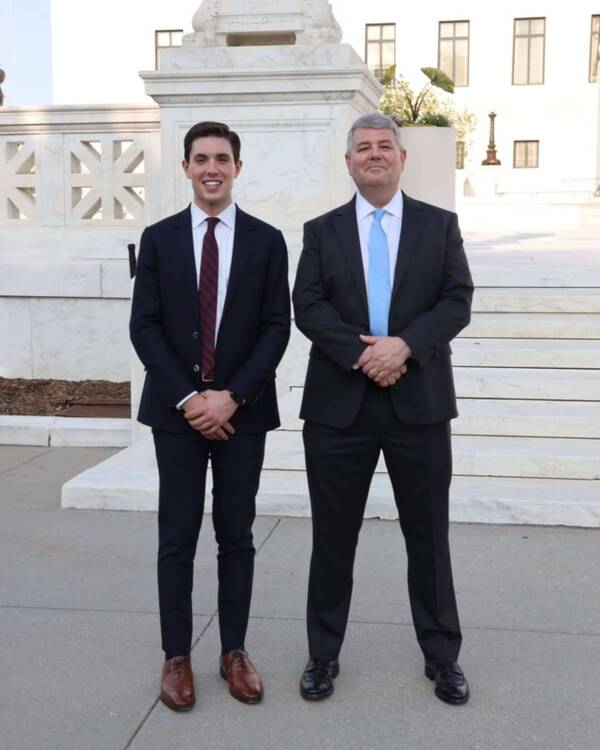
His research focuses on the relationship between law, politics, and religion in 20th-century United States history, with a particular emphasis on American Catholic legal thought. The author of nearly 20 academic articles in such venues as the Law and History Review and Journal of Law and Religion, Dennis has also worked to build an intellectual community around legal history during his time at Notre Dame.
One of his most significant initiatives is the Notre Dame Graduate Legal History Colloquium, a workshop series he founded in coordination with the American Society for Legal History. The workshop brings together students and scholars to present and refine works in progress. Launched in fall 2024, the series is held four or five times per year and provides early-career researchers with a platform to develop their legal history scholarship.
What drew him to Notre Dame was not just its academic reputation, but also its distinctive culture. “Of all the law schools to which I applied, Notre Dame was the only place where I found a critical mass of students who were not only academically driven, but who also didn’t neglect their personal and spiritual lives,” he said. “In this way, Notre Dame truly seemed distinctive.”
It might seem overwhelming to balance the demands of two rigorous programs while also serving as an assistant rector in Graham Family Hall. Yet Dennis describes it as “natural.” “Work doesn’t really feel like work when you’re doing what you love,” he said. “And even when I’ve been in a class that I didn’t love, I’ve always found opportunities to find a sort of mental reprieve by spending time on my work in the other discipline. Historians and lawyers often think with different parts of their brains, so my concurrent training has been extraordinarily beneficial to my overall intellectual formation.”

Beyond academics, Dennis has spent much of his time fostering community. His role in Graham Family Hall has been one of the most meaningful aspects of his Notre Dame experience . “As an assistant rector, you have the opportunity to contribute to other people’s personal and spiritual growth in a way that’s hard to replicate. I’m not sure there’s any real parallel to it,” he said. “Serving as an assistant rector was not something that I anticipated doing when I started at Notre Dame, but I’ve found it to be an incredibly rewarding experience.” For encouraging him to serve the university in this role, Dennis expressed gratitude to Fr. Bill Dailey, CSC, the rector of Graham Family Hall and the chaplain of Notre Dame Law School.
For Dennis, being a “different kind of lawyer” is a lived reality he has observed in both faculty and peers. He sees it in professors who are as attentive to students’ personal lives as they are to their professional success, and in students who view their futures in the legal profession as vocations rather than merely careers.

“The number of students here who do things for no other reason than they think it advances a greater mission is remarkable,” Dennis said. He points to his peers during his time in the Lindsay and Matt Moroun Religious Liberty Clinic as a prime example. “They often went far above and beyond what they were formally required to do because they felt like there was something really important at stake. That is a great illustration of the Law School’s motto lived in a very ordinary way.”
Dennis sees the success of his academic journey as inseparable from the mentorship he has received. “The incredible support of faculty both professionally and personally has exceeded anything I could have hoped for,” he said. “I owe any of my successes to their mentorship.”
After earning his law degree in May, Dennis plans to defend his dissertation in history in the spring of 2027. He will clerk on the U.S. Court of Appeals for the Third Circuit in 2028-2029.