2025 Notre Dame Religious Liberty Summit: Day 3 Recap
WEDNESDAY, JUNE 25
KEYNOTE ADDRESS
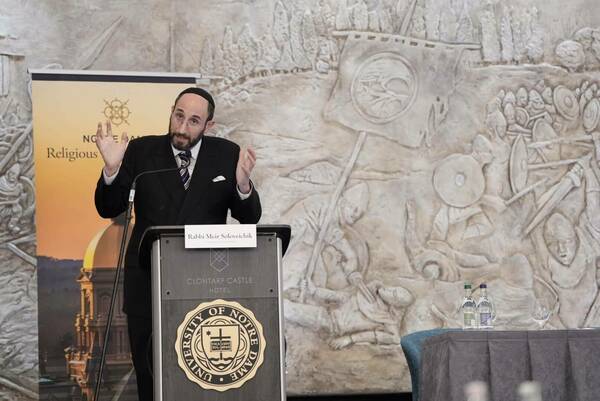
Rabbi Meir Soloveichik
Rabbi Meir Soloveichik of Congregation Shearith Israel delivered a powerful keynote address to open the final day of the 2025 Notre Dame Religious Liberty Summit in Dublin. Centering his remarks on the themes of faith and freedom, he drew deeply from the Bible—particularly the Book of Psalms, which he described as a “treasure trove that offers us a window into the interiority of the human being.” He reflected on how biblical teachings continue to shape and resonate with the uniquely American approach to religious liberty.
“[There is] an opportunity as academics or clergy or public officials to teach and speak about the founding principles of our country, but it is also a statement … to teach about the role that faith and scripture had in forming the uniquely American notion of liberty so that we can rediscover the foundation of the American identity.”
“America was born of religious difference and the belief that these differences should not be denied, but rather cherished … and kept safe from tyranny.”
Rabbi Meir Soloveichik, Congregation Shearith Israel
PANEL DISCUSSION
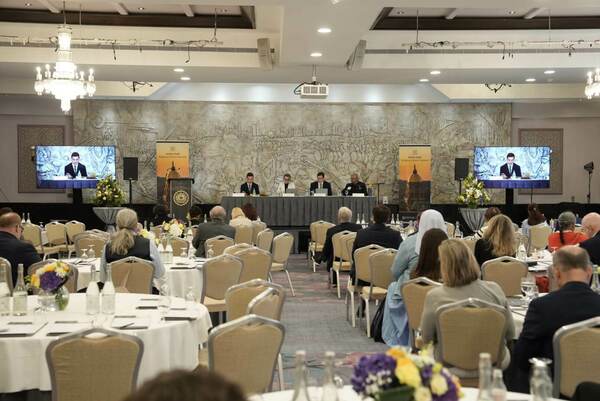
Threats to Civil Society - Religious Social Service Providers
The panel discussion “Threats to Civil Society - Religious Social Service Providers” at the Notre Dame Religious Liberty Summit featured insights from Msgr. Michael Nazir-Ali (Oxford Centre for Training Research Advocacy and Dialogue), Mr. Eric Rassbach (Becket Fund for Religious Liberty), and Dr. Ewelina Ochab (IBAHRI/Refcemi). The session was chaired by Professor John Meiser (Notre Dame Law School), director of the Lindsay and Matt Moroun Religious Liberty Clinic.
“We should be willing and available to be advocates of those who may be victims of extremist ideology, and who may be unable to defend themselves.”
Msgr. Michael Nazir-Ali, Oxford Centre for Training, Research, Advocacy and Dialogue
"When the government distinguishes among religions based on theological differences in their provision of services, it imposes a denominational preference and that triggers something called strict scrutiny in the law.”
Mr. Eric Rassbach, Becket Fund for Religious Liberty
“The idea behind parliamentary inquiries is to equip parliamentarians with information to be able to challenge governments when they're not doing enough. We've seen some progress on a number of different inquiries, but I think we are still far from where we should be right now.”
Dr. Ewelina Ochab, IBAHRI/Refcemi
“The difficulties around the world that we're encountering through religious freedom are not just about what a government might do at the individual level, but they're also about the need for mediating civil society, networks, groups, schools, and other organizations”
John Meiser, Notre Dame Law School
PANEL DISCUSSION
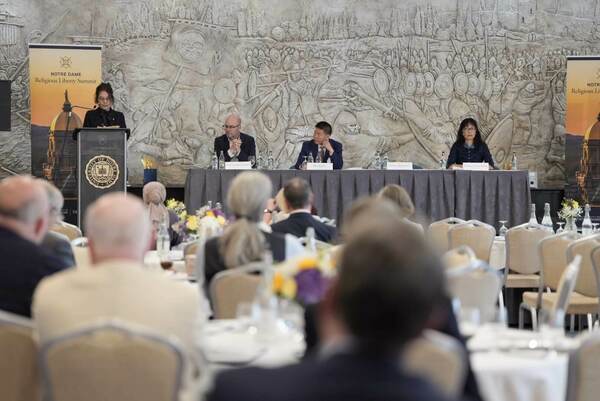
Suppression of Religion in China and Hong Kong
At the Notre Dame Religious Liberty Summit, the panel discussion “Suppression of Religion in China and Hong Kong” offered insights into religious freedom issues in Asia from Dr. Bob Fu (ChinaAid), Ms. Zubayra Shamseden (Uyghur Human Rights Project), and Professor Victoria Hui (University of Notre Dame). The session was chaired by Professor Rick Garnett (Notre Dame Law School).
“Any religion or faith or belief, whether it’s Tibetan Buddhism or Falun Gong or Catholicism or Christianity—if you have not made yourself in the absolute control or management of the Communist Party’s ideology, you are considered a danger to the society and a danger to the stability of the society.”
Dr. Bob Fu, ChinaAid
“There is not a judicial process. There is no appeal. Whole populations are swayed with high-tech equipment and in-person by party officials. Uyghurs are trapped. They’re facing arrest, enforced disappearances, modern day slavery in Chinese factories, family separation, and assimilation.”
Ms. Zubayra Shamseden, Uyghur Human Rights Project
“The government [of Hong Kong] controls funding. The government tells you that everyone, every single school, has to promote national education. You have to teach kids to love the motherland. This is what is going on in all the schools.”
Professor Victoria Hui, University of Notre Dame
“When political authority is underdeveloped [when] we don’t have the rule of law, religious freedom can be vulnerable. We've seen that in situations where civil society organizations are weak. Religious freedom can be vulnerable.”
Professor Rick Garnett, Notre Dame Law School
PANEL DISCUSSION
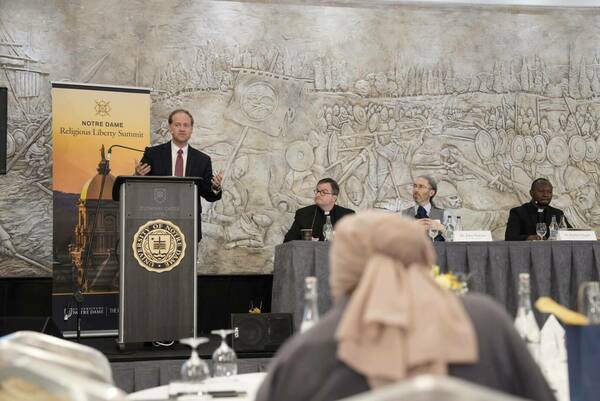
Persecution of Christians Worldwide
The final panel of the 2025 Notre Dame Religious Liberty Summit focused on “Persecution of Christians Worldwide.” The discussion featured perspectives from Dr. John Newton (Aid to the Church in Need UK), Sean Nelson (Alliance Defending Freedom International), and Fr. Stephen Ojapah (Okedejapah Trauma Victims Initiative), and was chaired by Rev. Wiliam Dailey, C.S.C. (University of Notre Dame).
“This is an issue that has not gone away, nor will it anytime soon. We need to hear the cries of our abused sisters and do all we can to share a light on their cases.”
Dr. John Newton, Aid to the Church in Need UK
“I'm very happy to say that there is much greater recognition of the need for religious freedom protections and violations, but to get that brought into law and into a place where governance is very challenged, that's going to take years.”
Sean Nelson, Alliance Defending Freedom International
"I want to end with a note of hope, because I'm still very hopeful that despite all that people are going through, there is still hope. There is still light at the end of the tunnel."
-Fr. Stephen Ojapah, Okedejapah Trauma Victims Initiative
Read the other daily recaps from the 2025 Notre Dame Religious Liberty Summit: