Q&A: Judge John “Jack” Blakey

A double Domer with deep Notre Dame roots, Judge John “Jack” Blakey ’88, ’92 J.D., grew up in South Bend. There, his father, Professor G. Robert Blakey, taught at the Law School and drafted the federal RICO Act, becoming its leading authority. After studying theatre as an undergraduate, he returned for his J.D. and built a career as a prosecutor—serving as an assistant U.S. attorney and in the Cook County State’s Attorney’s Office—before joining the federal bench.
What first drew you to a career in law and how much of a factor was your father in that decision?
I didn’t know I wanted to go into law until later in life, but I’d had plenty of exposure through my father. He was a law professor, a prosecutor for Bobby Kennedy in the ’60s, and a private attorney on both the defense and civil sides. My brother and two of my sisters are lawyers, so it was common to have amazing, interesting legal conversations at the dinner table.
He’s always been a role model—especially when I first started out as a prosecutor. It was like trying to be a songwriter when your dad is Elvis. People would say, “Oh, you’re Professor Blakey’s son!” and I was proud every time someone made that connection. He’s been instrumental in my career, not just in how I practice law, but in how I think as an attorney. I even had him for class. Of course, the grading was anonymous, and in my first year, four people wrote “Have mercy, Dad” on their exams—and none of them were me!
How did your experiences as a prosecutor shape your perspective on justice or prepare you for work on the bench?
When prosecution is done right, the goal isn’t to win—it’s to see that justice is done. When you don’t have a private client but a public one, you can advocate for the right answer in a way other lawyers sometimes can’t when they are obligated to pursue what’s best for their client, even if it’s not the best outcome for everyone else. As a judge, I don’t have any stake in the case at all—other than ensuring that justice is done under the law.
It was certainly a transition to become a judge, but my earlier work in civil litigation, criminal defense, and clerking (for Notre Dame alum William J. Zloch ‘66, ‘74 J.D., U.S. District Court in the Southern District of Florida) served me well. My experience as a prosecutor— especially the trial work—was instrumental. Conducting and managing a trial is a highly specialized skill.
What has surprised you most about being a judge?
One thing that maybe wasn’t surprising—but that I knew would be difficult—is sentencing. Sentencing is hard. In some ways, it’s impossible, but it has to be done. A really experienced judge, who’s no longer with us—once said, “When that part gets easy, you need to quit.” So I tell my staff I’m not in danger of quitting, because it’s never easy.
What do you find most rewarding about your work?
I love naturalization ceremonies. Imagine 500 people in a room, all beaming. I get to talk about things some people might call corny, about how great America is and the importance of our freedoms, but I believe they are all absolutely true. Everyone there to be naturalized appreciates the value of our country and our freedoms.
I tell them that being a U.S. citizen isn’t a spectator sport—you have to learn about the issues, vote, and serve on juries. I tell them it’s not just freedom from tyranny, but freedom to become something: how you raise your family, build a business, help others, worship God—whatever that may be. I end by saying, “Everyone will tell you how lucky you are to be an American, but on behalf of your new family, let me say how lucky we are to have you.”
Then I encourage them to cheer at the end. They’re so nervous at first so before the ceremony and administration of the oath, I make them practice cheering a couple of times, again louder, until the whole building wonders what’s heck is happening on the 25th floor. That’s when they realize this isn’t just a formality—it’s a celebration. That’s my favorite part of the job. I love it.
How have mentors influenced your career path, and how do you mentor others, especially your law clerks?
All my law clerks feel like my kids, except I don’t have to pay for their tuition! I really enjoy teaching them, they’ve become part of an extended family I still hear from.
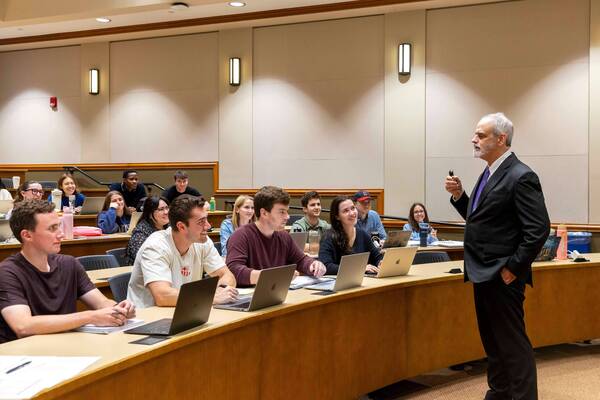
Mentoring also happens through my teaching at the Law School. I try to help students not just by teaching, but by guiding them as they make decisions about their careers.
Many people—especially first-generation students—haven’t had the same role models or opportunities as others, so it’s important to help them see paths they might never have considered. The Notre Dame network has been instrumental. It helped me early in my career, and while I may never fully be able to pay it back, I’ll definitely keep paying it forward.
With such deep ties, what does Notre Dame mean to you?
Notre Dame is part of my family—it’s been part of my memory for as long as I can remember. It’s more than just football, and it’s not so much the institution itself as it is the people. Some are friends I’ve known for more than 45 years; others are colleagues I may not know as well, but we still have a shared commitment—not only to doing important things, but to doing good in the world. I think there’s a self-selection of people who chose to come to Notre Dame and want to make the world a better place, and that creates a community I feel honored to be part of.