Q&A: Judge Edward S. Kiel

Judge Edward S. Kiel ’91 J.D. serves on the federal bench as a U.S. District judge for the District of New Jersey. After a long career in private practice, he made history by becoming one of the first two Asian American judges appointed to New Jersey’s federal judiciary. He is also the first Asian American Notre Dame Law School graduate to serve as a U.S. District Court judge. He reflects on his path from engineering to law, his Notre Dame experience, and the values that guide his work on the bench.
Please share a little about your background.
I was born in Daegu, Korea. My parents were refugees from the Korean War. They came from North Korea, and my father was sent to the United States by Christian missionaries to attend Princeton Seminary. Eventually, we moved to New Jersey, where my father founded the second-oldest Korean church in the state. He served as a minister there for many years.
I went to Rutgers and majored in electrical engineering. My intent was ultimately to go to law school and pursue patent law. I thought that career combined the things I enjoyed—math, science, and writing. That path didn’t quite happen the way I expected.
Can you tell me about any memorable experiences, or professors who influenced you at Notre Dame Law School?
I think back to the very first day of orientation. Dean Link got up and said two things. He told us, “Those Harvard and Yale lawyers are Cadillacs. You guys are Ferraris.” He also emphasized that Notre Dame Lawyers are a different kind of lawyer. Those words stayed with me.
Dean Link was already a legend, but he was also so approachable. His office was right by the library, and I remember being able to walk in with questions—sometimes even personal ones. Coming from a large state school where you didn’t really have that kind of personal interaction with important people was something I didn’t expect.
There was also a strong emphasis on ethics and doing the right thing. I think of Judge Murphy, who taught contracts, and Judge Rice, who taught torts. It wasn’t like the movies where law school seemed cutthroat. We shared notes, we helped each other, and while it was stressful and demanding, it wasn’t hyper-competitive.
Of course, I remember the lighter side—the bowling league with 10-cent beer nights, the softball games, bookstore basketball. Those moments of camaraderie are some of my best memories from Notre Dame.
What led you to the judiciary—was becoming a judge always your plan?
I didn’t come out of law school expecting to be a judge. My first job was at one of the largest law firms in New Jersey, and the hiring partner took a chance on me and she gave me my start in big law. I moved between a few firms and eventually became a partner at one of the largest firms in New Jersey, and had a very good career. But after many years of grinding it out, I wanted to try something different.
I saw a Federal Bar advertisement for a magistrate judge position in New Jersey. At the time, there were no Asian judges in New Jersey’s federal judiciary. In 2019, I was appointed as a magistrate judge. Later I met a staffer from Senator Cory Booker’s office and through that connection I was nominated by President Joe Biden, and in 2024 I became the second Asian Article III judge in New Jersey.
How would you describe your judicial philosophy?
There’s an old saying—something like “culture eats strategy for breakfast.” That idea captures what I try to build in my chambers. It’s less about a formal judicial philosophy and more about the culture we create. I remind my team that we’re in the customer service business. Our job is to serve—treating every case as important, whether it’s the biggest antitrust matter or a slip-and-fall in federal court based on diversity jurisdiction. We work hard, respect counsel and pro se litigants alike, and aim to move cases along as quickly as possible.
As for resolving cases, I try to keep it straightforward: look at the law, apply the facts, and be faithful to both.
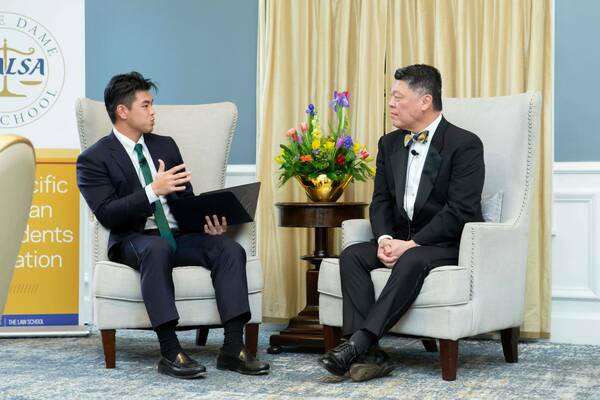
What role do you think judges should play in mentoring the next generation of legal professionals?
When I interview potential law clerks, I ask: “Why do you want to clerk in New Jersey?” I want to give opportunities to people who plan to stay here and practice in front of me, not someone with no connection to this district.
For me, mentoring also means opening doors for people who might not normally have access to a federal clerkship. There are so many bright students from underrepresented backgrounds, or from less advantaged circumstances, who deserve a chance. Giving those students an opportunity—knowing it could be a springboard to their entire career—is one of the most important things I can do as a judge.
Is there anything else you’d like to share?
I’m very proud to be a Notre Dame Law School alum, especially in New Jersey. I don’t come across many ND Law alumni here, but when we do see each other, there’s always that instant connection.