News Briefs
Inaugural Justice Amy Coney Barrett Moot Court Tournament culminates in strong competition and awards for top teams

Notre Dame Law School’s inaugural Justice Amy Coney Barrett Moot Court Tournament, held on November 8, 2024, was a resounding success, showcasing the advocacy and writing skills of second- and third-year law students.
A distinguished panel of judges presided over the final round, including U.S. Supreme Court Justice Brett Kavanaugh, Judge Elizabeth Branch of the U.S. Court of Appeals for the Eleventh Circuit, and Notre Dame Law alumnus Judge Jerry Pappert ’88 J.D. of the U.S. District Court for the Eastern District of Pennsylvania.
The tournament began in September with 32 oralists and seven briefs and concluded with a highly competitive final round. Third-year law students Gabriel Powell and Thomas MacPhee, serving as respondents, were awarded first place for their compelling arguments, with MacPhee also earning the Best Oralist Award. Marin Larkin and Kathleen Casey, serving as petitioners, secured second place for their exceptional advocacy. Recent alumna Brianna Ivy ’25 J.D. received the Best Brief Award for her outstanding written work.

Dean G. Marcus Cole said, “This tournament honors Justice Amy Coney Barrett’s legacy of legal excellence and celebrates the extraordinary talent of our students. We are all incredibly proud of their dedication and the seriousness with which they approached this competition. Their performances demonstrate the high level of excellence that defines Notre Dame Law School. I couldn’t be prouder of what our teams accomplished during our first competitive tournament.”
The competition was centered on a fictional appellate case on Fourth Amendment questions regarding border searches of cellphones and digital privacy. The finalists debated the legality of forensic cell phone searches under the border-search exception.
This year’s Justice Amy Coney Barrett Moot Court Tournament was held on November 21, 2025.

Notre Dame Law School Expands Partnerships in Africa and Brazil
As one of the Law School’s key priorities, the Global Lawyering Initiative advances Notre Dame Law School’s commitment to preparing students with a comprehensive understanding of legal issues that transcend national borders. This commitment takes shape through the initiative, which leverages strategic partnerships to expand global opportunities for faculty and students through research collaboration and academic exchanges.

To advance this priority, the Law School has established full partnership agreements with institutions in Africa and Brazil: Strathmore Law School in Nairobi, Kenya; the Constitutional Court of South Africa; the University of Cape Town in South Africa; Insper in São Paulo, Brazil; and Fundação Getulio Vargas in Rio de Janeiro, Brazil. Led by Dean G. Marcus Cole, a delegation from Notre Dame Law School visited Africa and Brazil in January and March, respectively, with the goal of strengthening relationships with these institutions.
The delegation engaged in a wide range of activities—from Memorandum of Understanding (MOU) signings and public lectures to alumni gatherings and joint academic conferences—showcasing the Law School’s expanding global footprint.

“Notre Dame Law School is committed to training lawyers and leaders of the future, and the future of law is transnational. The best lawyers will be ones who can lead and solve problems all around the world,” said Dean Cole. “These strategic partnerships not only enhance our international presence, but also allow Notre Dame Law School to promote global academic excellence while broadening opportunities for our faculty and students consistent with our Catholic mission.”
The Global Lawyering Initiative aligns with the Law School’s mission to cultivate lawyers who view the practice of law as a service to others, not just a profession, and who are dedicated to advancing justice and human dignity on a global scale.

From Courtrooms to Communities: Global Human Rights Clinic in Action
Notre Dame Law School’s Global Human Rights Clinic, led by Professor Diane Desierto, provides students hands-on experience advocating for human rights worldwide. Students engage in legal representation, human rights training, and advocacy for legislative and policy reforms through work with courts, tribunals, and global organizations. The following highlights showcase the Clinic’s global reach, diverse initiatives, and impact.
Collaboration with U.N. Development Programme on Women and Justice in the Asia-Pacific
The Clinic launched the Women and Justice in the Asia-Pacific project, which involves fact-finding investigative research and international human rights training that examine the obstacles, opportunities, and capacities available to women lawyers, justice professionals, and judges in Indonesia, Bangladesh, Thailand, and Laos. The Clinic is also conducting interviews with judges and other justice professionals from these countries to contribute to the final report and judicial leadership training module on Women and Justice in the Asia-Pacific. The final report was launched in October 2025 at UNDP’s regional conference with Asia-Pacific courts in Bangkok, Thailand.
U.N. Guidelines on Human Rights and Corruption and Knowledge Hub on Economic, Social, and Cultural Rights
The Global Human Rights Clinic completed a collaborative project with the U.N. Office of the High Commissioner for Human Rights (U.N. OHCHR) in Geneva. The team authored the 120-page United Nations Guidelines on Human Rights and Corruption, to be officially adopted by the U.N. Human Rights Council in 2025 and disseminated to all States and U.N. agencies. Last May, the Clinic co-hosted a consultation roundtable on the guidelines with experts from the U.N. OHCHR in Geneva, held at the University of Notre Dame’s Washington, D.C. offices. U.N. OHCHR launched the guidelines in the fall of 2025.
Collaboration with the U.N. International Organization of Migration
The Clinic is working with the United Nations International Organization of Migration and their respective country offices in Ethiopia, Colombia, and Sri Lanka. They are focused on examining and investigating areas for improving international human rights protection, policy, and legislative reform. The collaboration will look for consistency with international human rights law in housing, land, and property access, use, and sustainable environmental stewardship by vulnerable displaced groups in these three countries. Such groups include internally displaced persons (IDPs), indigenous peoples, rural women farmworkers, persons of African descent, and campesino or peasant communities.
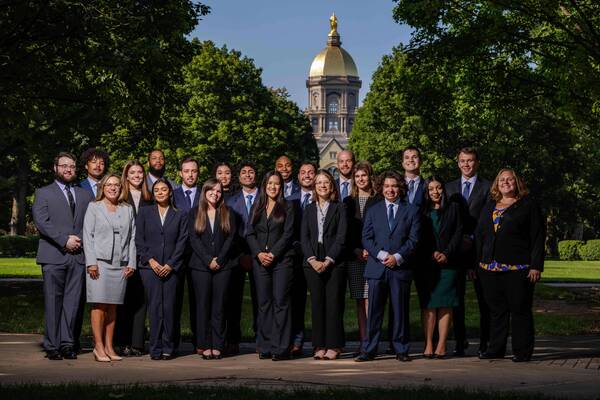
Meet the Class of 2028
In fall 2025, the Class of 2028 arrived on campus, officially joining the Notre Dame Law School community.
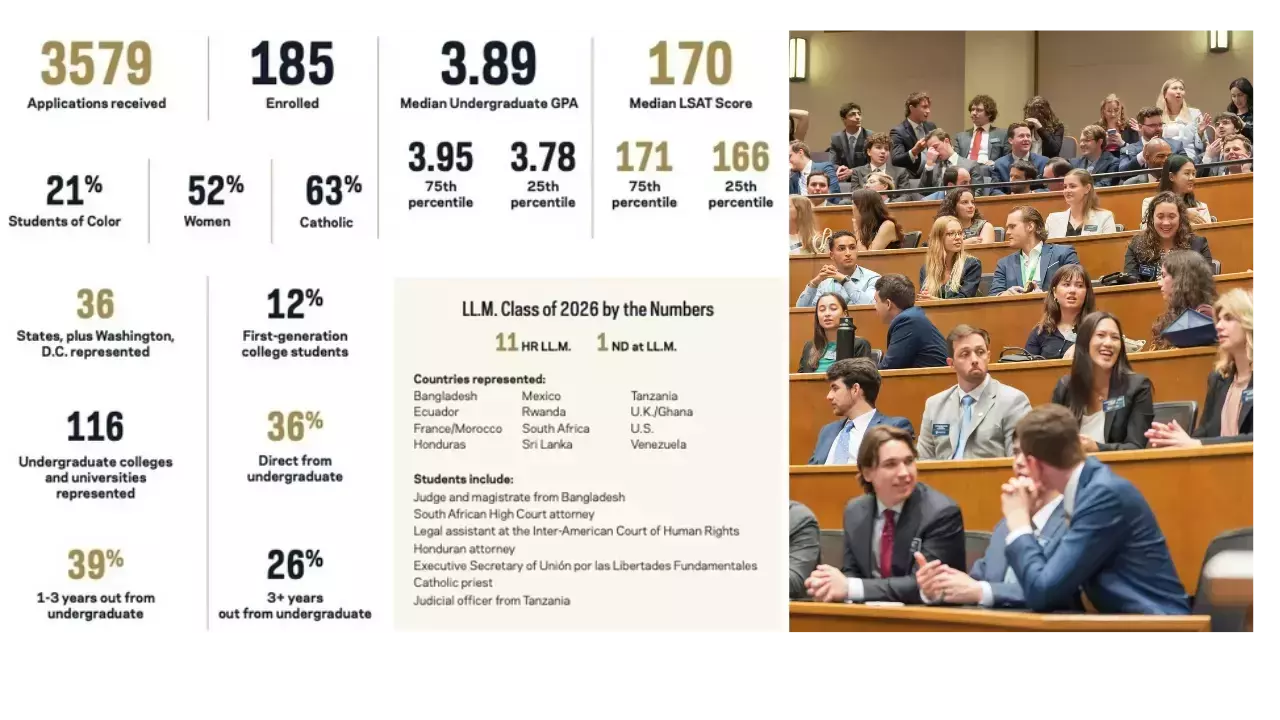
Dean’s Initiative for Leadership and Scholarly Excellence Equips First-Year Law Students for Academic and Professional Success
Two weeks before the start of the academic year, a select group of 19 incoming J.D. students arrived at Notre Dame Law School to participate in the inaugural Dean’s Initiative for Leadership and Scholarly Excellence (LSE) program.
Designed to support students with limited exposure to the legal profession or from traditionally underrepresented backgrounds, the LSE program fosters academic, professional, and personal growth through mentorship, foundational coursework, and professional development to help students build a strong foundation for success in law school. The two-week program, established by Dean G. Marcus Cole, was modeled after a similar program that Cole participated in as a law student at Northwestern University.

“I thought about my experience in that program leading up to law school. I wanted to replicate that and put students with exemplary leadership experience in a program where we give them exposure to what they are about to learn in law school,” said Cole.
The LSE cohort experienced sample lectures in Legal Writing, Contracts, Property, and Civil Procedure, serving as an introduction to their doctrinal classes, legal reading and writing, and preparing for classes. The students also gained insight into financial support, wellness services, exam preparation, and career development through workshops, sessions, and individual resource meetings with Law School staff.
In addition to academic and professional preparation, the LSE program provides tangible financial support to its participants. Each member of the cohort received a one-time $2,000 housing stipend.

By providing additional guidance and a structured schedule before classes even began, the LSE program helped its inaugural cohort enter law school with confidence, connection, and a clear sense of purpose. The comprehensive program set the tone for their first year— equipping them not just for academic success, but for leadership within and beyond Notre Dame Law School.

Experts from Across the World Convene at Fifth Annual Notre Dame Religious Liberty Summit
Each year, Notre Dame Law School hosts the Notre Dame Religious Liberty Summit, bringing together expert scholars, advocates, and faith leaders for robust discussions on complex global religious liberty issues and the future of religious freedom on the worldwide stage. This year’s fifth annual Notre Dame Religious Liberty Summit was held in Dublin, Ireland at the historic Clontarf Castle and centered on the theme of “Political Authority, Civil Society, and Religious Freedom.”
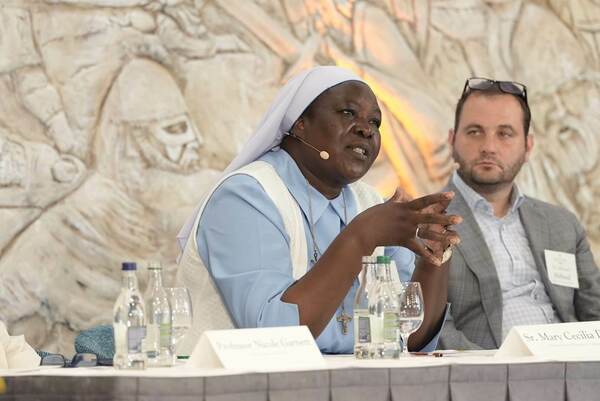
The Summit featured over 20 speakers in panel discussions and keynotes on topics such as the suppression of religion in China and Hong Kong, the persecution of Christians worldwide, and combating religious oppression by powerful states. Over 100 leading scholars, faith leaders, and advocates attended the event.
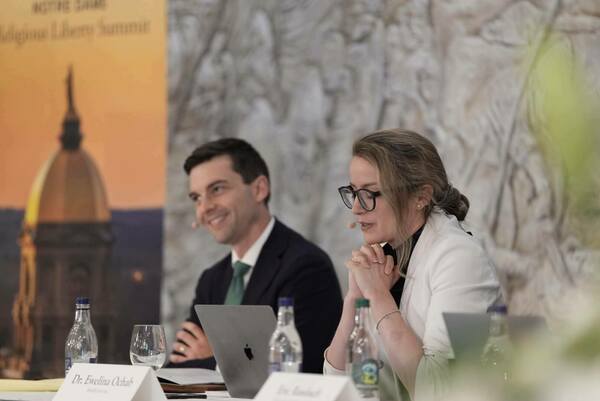
The panel discussions explored the rising global threats to religious freedom and the vital role of civil society in defending it. Experts highlighted how powerful states use legal, social, and political pressures to stifle religious belief and practice. Other panels examined how attacks on religious education and faith-based social services weaken civil society’s capacity to protect vulnerable communities and promote pluralism. Together, the conversations underscored the need to resist religious oppression and strengthen the institutions that sustain freedom of conscience worldwide.
The summit’s culminating event was the Religious Liberty Awards Dinner. The 2025 Notre Dame Prize for Religious Liberty was awarded to Professor Michael McConnell of Stanford Law School. The 2025 Religious Liberty Scholarship Award was presented to Dr. Russell Hittinger ’75 of the Catholic University of America. The summit also featured a number of cultural experiences for attendees, including a visit to the Four Courts, which houses the Supreme Court of Ireland.

“If we are to win the case for religious freedom, we cannot settle for winning that case in the court of law,” said Dean G. Marcus Cole. “We must also win in the court of public opinion, and that court is in each heart. We cannot win hearts with reason. We must win hearts with love.”

Learning from the Nation’s Highest Court
It is not every day that law students have the chance to learn from a distinguished jurist—let alone two sitting justices of the United States Supreme Court. During the 2025 fall semester, Notre Dame Law students experienced just that, with the opportunity to take short courses taught by Justice Amy Coney Barrett ’97 J.D. and Justice Brett Kavanaugh.
In August, Justice Barrett returned to Notre Dame to teach Modern Constitutional Theory, a weeklong seminar exploring major theories of constitutional interpretation, with a special focus on the debates surrounding originalism.
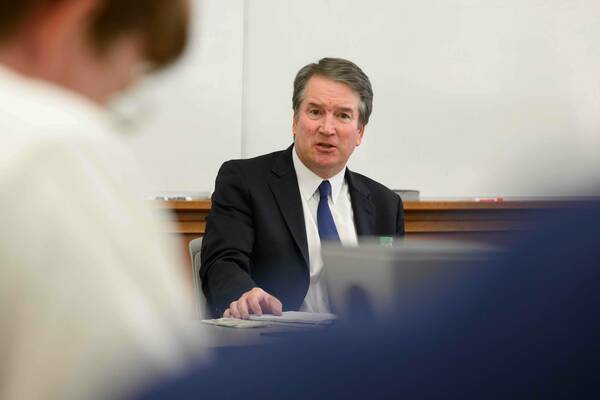
Just two weeks later, Justice Kavanaugh joined Professor William Kelley for a Supreme Court Seminar course, offering students insight into the Court’s workings and decision-making process.
In addition, Chief Judge Jeffrey Sutton of the U.S. Court of Appeals for the Sixth Circuit co-taught Advanced Topics in Constitutional Law with Professor Kelley, further broadening students’ exposure to leading members of the judiciary.
Student Perspectives

Third-year student Steven Tu said, “Beyond the once-in-a-lifetime opportunity to learn from a sitting U.S. Supreme Court justice, Justice Barrett is someone I’ve always admired for her principled approach to constitutional interpretation and her integrity as a judge.” He added that the course deepened his respect for judges who “wrestle with these questions every day.”
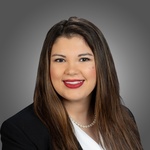
Grace Cala, also a third-year student, described the seminar as “an actual dream come true, and my most memorable moment at Notre Dame Law School.” She was struck by Justice Barrett’s passion for teaching and said she would carry with her the Justice’s advice on “balancing faith, family, and a legal career.” She reflected, “As a law student, it’s easy to be intimidated by SCOTUS opinions, but it’s important to remember that cases are resolved by human beings who actually think a lot like we do.”

Kresge Law Library Becomes Home to St. Thomas More Collection
The shelves of the Kresge Law Library are rich with more than 400 volumes tied to the life and legacy of St. Thomas More, thanks to a gift from St. John’s University School of Law in Queens, New York. The collection, 431 items spanning 293 unique titles, arrived at Notre Dame as part of a reorganization project. Rather than dispersing the works, St. John’s sought a home where the volumes would be preserved and accessible to scholars, students, and future generations.
Few figures in history embody the union of faith, intellect, and law as fully as St. Thomas More. Born in London, More was educated at Oxford and trained at Lincoln’s Inn before rising to prominence as a lawyer, undersheriff, member of Parliament, Speaker of the House, and ultimately Lord Chancellor of England.
Among the legal community, More’s influence is deep and multifaceted. His professional excellence, intellectual acumen, and sharp wit serve as enduring ideals for lawyers and judges; he represents the archetype of a legal scholar who leverages rigorous reasoning and ethical principles to navigate complex moral and legal issues.

Highlights of the Collection
The collection showcases the breadth of More’s influence, both during his lifetime and across the centuries. Among the collection’s highlights are:
Beatificationis seu Declarationis Martyrii Servorum Dei (1881) Held by only three libraries worldwide, this rare volume documents the Church’s formal recognition of More’s martyrdom.
Utopia (1639 English translation) One of the earliest English- language editions of More’s masterpiece, still widely read today.
Mirror of Virtue in Worldly Greatness: Life of Sir Thomas More by William Roper (1817) Written by More’s son-in-law, this intimate biography provides a firsthand perspective on his life and character.
Epigrammata (1520) A collection of over 250 Latin poems, many reflecting on politics and governance, showcasing More’s wit and literary skill.
Dialogue of Comfort Against Tribulation (1534) Written during his imprisonment in the Tower of London, this deeply personal work encourages perseverance in the face of suffering, balancing profound spiritual insight with humor and sharp political commentary.

Lardy Scholarship Award: Amanda Garcia
Amanda Garcia is the recipient of the Peter A.R. Lardy Scholarship Award for the 2025-26 academic year. The scholarship was established by the Notre Dame Law Class of 1975 to honor their classmate Peter A.R. Lardy, who died of cancer during his third year of law school. The award is presented annually to a rising third-year student “who exemplifies his courage, love, and understanding toward his fellow man” and includes substantial tuition assistance.
“The Lardy Scholarship is more than just financial support,” said Garcia. “Receiving this award is a powerful reminder that people believe in me and in my future—not just as a lawyer, but as an advocate. It reaffirms my own belief that anyone can do this. I’m the first in my family to attend law school and become an attorney, and I carry that with deep pride.”
Garcia has been deeply engaged in the Notre Dame community. She served as president of the Women’s Legal Forum and Tax Law Society last year, and treasurer of the Student Bar Association. In addition to her leadership roles, Garcia is a member of Jus Vitae, the St. Thomas More Society, and the Federalist Society. Outside of Notre Dame Law School, Garcia volunteers for Sleep in Heavenly Peace, an organization dedicated to constructing beds for children in need. She is also a Sorin Fellow for the de Nicola Center for Ethics and Culture and extern for the Office of Institutional Equity.
Garcia received heartfelt nominations from members of the Notre Dame Law School community, who praised her extraordinary character and the kindness, generosity, and courage she shows to others. Her support has inspired not only first-year students and recent graduates, but also fellow transfer students navigating their own transitions. One classmate shared, “She embodies Notre Dame’s vision of a ‘different kind of lawyer’— one who approaches the law not simply as a career, but as a calling to serve justice, community, and love. Her courage, compassion, and character are not only extraordinary—they are transformative.”
Religious Liberty Clinic Students Help Prepare Religious Charter School Case for U.S. Supreme Court
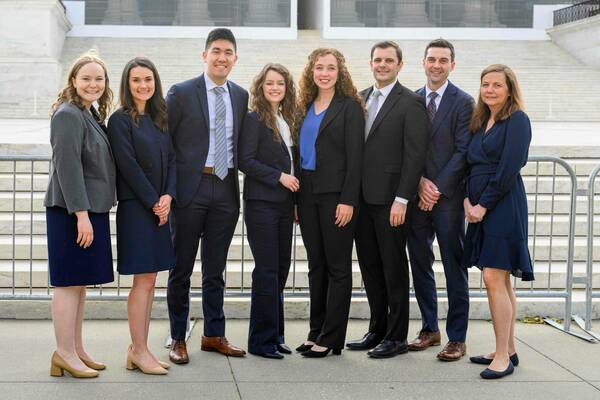
Days before graduating, then third-year Notre Dame Law student Hadiah Mabry ’25 J.D. attended oral arguments at the U.S. Supreme Court for a high-profile case she helped litigate through the Law School’s Lindsay and Matt Moroun Religious Liberty Clinic.
The case, St. Isidore of Seville Catholic Virtual School v. Drummond, challenged Oklahoma’s exclusion of religious schools from a private charter program, arguing that the policy amounts to unconstitutional religious discrimination.
Mabry was among five current and former Law School students who worked on the case with the Religious Liberty Clinic, led bythe clinic’s director John Meiser ’07, ’10 J.D. and staff attorney Meredith Holland Kessler ’14, ’18 J.D. in collaboration with Nicole Stelle Garnett, the John P. Murphy Foundation Professor of Law. Notre Dame alumnus Michael McGinley ’06 of Dechert LLP presented oral arguments for the school, with Meiser as second-chair counsel.
“It was truly an honor to experience oral arguments at the Supreme Court,” Mabry said. “Very few lawyers get to see a case they worked on go to the Supreme Court, and I’m so grateful to the Religious Liberty Clinic for making this possible while we were still in law school.” The students helped prepare for oral argument at the Supreme Court. Meiser said it’s hard to overstate how meaningful the experience was for the students.
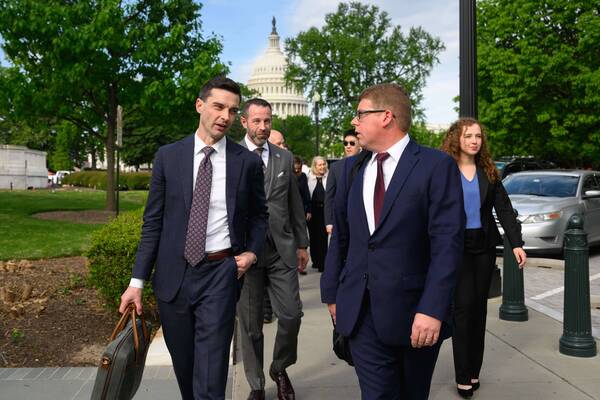
“They used their legal skills to help a new school grow from the ground up. They navigated complicated regulatory processes, worked on two separate litigations and then had the rare chance to help prepare for oral argument before the highest court in the country. Lawyers go their entire careers without opportunities like our students have gotten.”
Attorneys argued that religious organizations in Oklahoma have the constitutional right to have access to a state program that allows other private groups to operate charter schools, and to deny St. Isidore’s charter constituted unlawful religious discrimination. The Supreme Court upheld the Oklahoma Supreme Court’s decision in a split 4-4 decision.
“We have given our students legal experiences that can’t be replaced and which I could never have imagined during my own time as a Notre Dame student,” said Meiser. “And we did it all alongside, and because of, so many great people from Notre Dame.”
New Clinics
Notre Dame Law School continues to expand hands-on learning opportunities for students while deepening our service to the community. This year, we launched three new clinics that significantly broaden the scope of pro bono legal assistance our students provide.

Immigration Clinic
Directed by Clinical Associate Professor Ashley Sanchez, the Immigration Clinic offers pro bono representation in asylum, citizenship, bond hearings, DACA, and family reunification cases. Students advocate for clients before U.S. Citizenship and Immigration Services and in Immigration Courts.

Intellectual Property Clinic
Led by Clinical Associate Professor Grace Mills ’15 J.D., the Intellectual Property Clinic will serve innovators, artists, educators, and other creators. Students will advise on patents, trademarks, copyright, and fair use, helping clients protect their work while gaining hands-on experience.

Veterans Law Clinic
Clinical Associate Professor Caleb Stone leads the Law School’s new Veterans Law Clinic, dedicated to providing free legal assistance to U.S. military veterans in matters such as disability claims and appeals. Read more about the Clinic here.
Clerkships
Notre Dame Law School continues to demonstrate exceptional success in placing its graduates into prestigious judicial clerkships. More than 17 percent of the Class of 2024 entered federal clerkships upon graduation—ranking fifth among American law schools.
A total of 36 graduates earned 45 clerkships, including one at the U.S. Supreme Court, 15 with the U.S. Courts of Appeals, and 20 with U.S. District Courts. Nine graduates also clerked in specialized federal courts—such as the U.S. Court of Federal Claims, U.S. Bankruptcy Court, and U.S. Court of International Trade—while another nine secured positions in state courts, including six on state supreme courts.
Across the classes of 2020–2024, graduates have secured at least 253 clerkships in federal, state, and local courts nationwide, including placements at the U.S. Supreme Court.

Clerked for Judge Thomas Kirsch of the
U.S. Court of Appeals for the Seventh Circuit
“I will forever be grateful for the year I spent as a judicial law clerk. When I applied for and accepted my clerkship, I looked forward to the invaluable research and writing skills I would develop and the public service opportunity a clerkship would provide. I have gained an incredible mentor in my judge and lifelong friendships with my co-clerks.”

Clerked for Judge Eleni Roumel of the
U.S. Court of Federal Claims
“Beyond the writing experience and unique opportunity for mentorship the job provides, I am constantly reminded in this role of what our job as attorneys is truly about: serving the country, the legal system, and the individual parties. Notre Dame does an amazing job of cultivating a love of the law in all students, and my experience clerking has deepened that appreciation and passion.”
Clerking at the Highest Court
Michael Bradley clerking for Justice Samuel Alito

A triple Domer, Michael Bradley ’14, ’17 M.T.S., ’22 J.D. earned both his undergraduate degree and a master’s in theological studies from Notre Dame before enrolling in law school.
Law runs deep in Bradley’s family. His father, Professor Gerard Bradley, taught at Notre Dame Law School for over three decades, and his brother, Timothy Bradley ’20 J.D., clerked for Justice Amy Coney Barrett during the 2022 term.
After graduation, Bradley clerked for Judge Thomas Hardiman of the U.S. Court of Appeals for the Third Circuit and Chief Judge William Pryor of the U.S. Court of Appeals for the Eleventh Circuit. He also worked as an associate at Jones Day in Washington, D.C
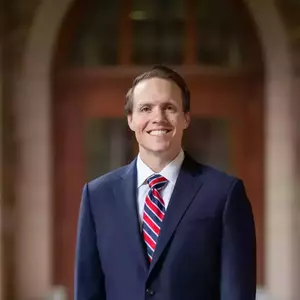
William Eisenhauer clerking for Chief Justice John Roberts
Originally from Dayton, Ohio, William Eisenhauer ’23 J.D. graduated from the United States Naval Academy in 2015. He served as a submarine officer for five years before pursuing law school.
At ND Law, he earned top honors and received the Colonel William J. Hoynes Award for the Class of 2023—the Law School’s highest academic honor, recognizing outstanding scholarship, application, conduct, and achievement.
Eisenhauer previously clerked for Judge Ben Beaton of the U.S. District Court for the Western District of Kentucky. Immediately after graduating, he clerked for Judge Amul Thapar of the U.S. Court of Appeals for the Sixth Circuit.

Eviction Clinic Helps Shape Indiana Law Expanding Access to Eviction Expungement
Notre Dame Law School’s Eviction Clinic has long been a cornerstone of the Law School’s commitment to public service and hands-on legal education. In the clinic, students work alongside Professor David Pruitt ’92, ’99 J.D. to represent clients facing eviction and related proceedings in St. Joseph County, Indiana.
In spring 2024, a conversation between Indiana State Senator Liz Brown ’80, Pruitt, and his students sparked a broader effort to reform state law. They identified a key problem: prior eviction cases, regardless of their merit or even if they were dismissed, often make it extremely hard for tenants to secure new housing.
Students in the class, together with Pruitt and the Indiana Justice Project (IJP), researched the issue and co-authored a white paper recommending reforms. Their proposals became the foundation of Senate Bill 142, with Senator Brown serving as the bill’s primary author.
During the 2025 Indiana legislative session, clinic students joined Pruitt in testifying in support of the bill. Signed into law last spring, the measure ensures automatic sealing of dismissed cases and clarifies that tenants who pay off judgments are eligible for sealing. Advocates say the reforms will improve housing stability for thousands of Hoosiers, while giving Notre Dame Law students a powerful example of how their advocacy can spark systemic change.
Notre Dame Law School Becomes First to Partner with Harvey AI
Notre Dame Law School has become the first law school to partner with Harvey AI, a generative artificial intelligence platform built specifically for the legal profession. Already adopted by 70 percent of AmLaw 10 firms and nearly 50 percent of AmLaw 100 firms, Harvey is now being integrated into legal education at Notre Dame Law School to prepare students for a rapidly evolving legal marketplace. The collaboration reflects a growing recognition that tomorrow’s lawyers must be fluent in AI. By equipping students with practical training on Harvey, the Law School aims to give graduates a competitive advantage from the start of their careers.
“Artificial Intelligence is here. It is increasingly more sophisticated and will rapidly become more integral to our work,” said Dean G. Marcus Cole. “Law firms and organizations will expect expertise in the use of AI, so it is incumbent upon us to prepare our students to utilize it effectively and ethically. We are excited to be a pioneer in legal education, partnering with Harvey to bring this critically important education to our students, preparing them to work for the common good.”
The partnership began in fall 2024, when Notre Dame Law librarians received training on the Harvey platform. By spring 2025, the initiative expanded to two Advanced Legal Research courses where students used Harvey to supplement their coursework. Through this pilot program, students explored how AI can streamline legal research, distill complex information, and support more efficient analysis.
The initiative underscores Notre Dame Law School’s longstanding commitment to producing practice-ready graduates. More than half of each graduating class join leading firms where AI is already reshaping daily legal work. By providing students with hands-on experience using tools that are becoming industry standards, Notre Dame ensures its graduates are well-positioned to succeed in technology-focused environments.

Pat Manion: Global Business Development at Harvey
Pat Manion ’18 J.D. manages global business development at Harvey. Before joining Harvey, he practiced white-collar and securities law at Jones Day and later served as chief of staff and assistant general counsel at Robinhood. At Harvey, Manion has played a key role in expanding the company’s international presence and building strategic partnerships.
In 2024, he returned to Notre Dame Law School to speak on a panel about the growing impact of artificial intelligence in the legal profession.
Rev. David T. Link Public Interest Banquet Celebrates Lawyers Dedicated to Public Service

In October 2025, Notre Dame Law School hosted the fourth annual Rev. David T. Link Public Interest Banquet, celebrating lawyers who dedicate their careers to serving others. The event honors the legacy of former Dean Rev. David Link, whose life exemplified service and a deep commitment to others.
This year’s South Bend Community Award honored Rudy Monterrosa '01 J.D., whose career has been defined by tireless advocacy forthe disadvantaged and marginalized. As founding attorney of the Monterrosa Law Group, he has practiced criminal, immigration, and family law in South Bend and made history as St. Joseph County’s first Latino deputy public defender.
The Rev. David T. Link Impact Award was presented to Andrea Kerby ‘18 J.D., a pro bono staff attorney at Cabrini Green Legal Aid, who embodies the union of vocation and purpose through her record of relief work and her mentorship of future attorneys committed to justice.
The annual banquet is organized by the student-led Public Interest Leadership Council.