Judge Charles R. Wilson: Where Preparation Meets Opportunity

A career that reached higher than he ever planned—and that opened doors for nearly 50 Notre Dame alumni clerks
Judge Charles R. Wilson ’76, ’79 J.D., believes success happens with something we control—and something we don’t.
“I teach my law clerks,” he said, “that success comes when preparation intersects with opportunity.”
Wilson would know. In a 45-year career in law, Wilson has represented clients in state and federal courts, served as the top federal prosecutor in one jurisdiction, and is now a member of the federal judiciary. As he says, the opportunities arise. But it’s what every judge and lawyer controls that makes the difference.
“The best lawyers are ethical, trustworthy in their representations to the court, and meticulously prepared," Wilson said. "They observe the five Ps: prior preparation prevents poor performance."
On the United States Court of Appeals for the Eleventh Circuit, Wilson hears cases that present constitutional, criminal, civil, and administrative issues. It's a court where several remedial statutes approved by Congress in the 1960s—to address racial discrimination in Southern states—continue to appear in present-day disputes. The circuit covers Florida, Georgia, and Alabama.
"All three states have the death penalty, which means we routinely entertain appeals from the denial or grant of writs of habeas corpus by death row inmates. And given the Supreme Court's limited docket, we are, for the most part, the federal court of last resort in these states. To have a role in the development of decisional law in the Eleventh Circuit is the most rewarding aspect of my job," Wilson said.
Wilson has served on three-member panels in the Eleventh Circuit since 1999. Early in his tenure, he was assigned to high-profile cases that dominated headlines and public debate: Schiavo v. Schiavo, Bush v. Gore, and Elian Gonzalez v. Reno.
"Although every case is equally important, the high-profile ones require special attention because the eyes of the public are on you. The reputation of the court as an institution—and the public's confidence in our judicial system—are at stake," Wilson said.
A fourth-generation Floridian, Wilson has lived most of his life in Tampa. As a senior at Jesuit High School, his father—an attorney at the time—took him to visit just two colleges: Georgetown University and the University of Notre Dame.
"It didn't take long after we got out of the car on the Notre Dame campus that I decided Notre Dame was the place for me," Wilson said.
In 1972, Wilson entered Notre Dame as a member of the first class of freshman coeds. He majored in government and lived at Grace Hall, where he met roommates who remain friends today. And it was an encounter with Dean David Link that compelled him to choose Notre Dame for his law degree.
"I'm told that Dean Link personally selected every member of my class, the Class of 1979. So thanks to Dean Link, I'm a double Domer," Wilson said. "Twenty-five years later, Dean Link called to invite me to serve on the Law Advisory Council, where I continue to serve today."
Wilson's experience began as a law clerk for Judge Joseph W. Hatchett on the United States Court of Appeals for the Fifth Circuit in 1979. He became an assistant county attorney in Hillsborough County in Florida, in 1980, where he served until opening a private practice in Tampa in 1981.
He practiced as a solo practitioner for five years, handling a wide range of cases and trying jury and nonjury trials in state and federal court.
He also contributed to civic and charitable organizations, building a strong reputation that led Florida Governor Bob Graham to appoint him as a county judge in 1986. Wilson presided in Hillsborough County until 1990 before serving four years as a U.S. magistrate judge in the Middle District of Florida. At the recommendation of Attorney General Janet Reno, President Clinton appointed him U.S. Attorney for the district in 1994 and, five years later, to the United States Court of Appeals for the Eleventh Circuit.
"As fate would have it, although I was rejected after multiple applications for a job as an assistant United States attorney early in my career, 15 years later, I became the United States Attorney," Wilson said.
"And although I failed three times upon applying for appointment to the District Court, today I serve on the Court of Appeals, reviewing the decisions of the district judges who got the job I wanted. These experiences illustrate the value of perseverance, resilience, and more importantly, being professionally prepared to take advantage of the opportunity when it presents itself."
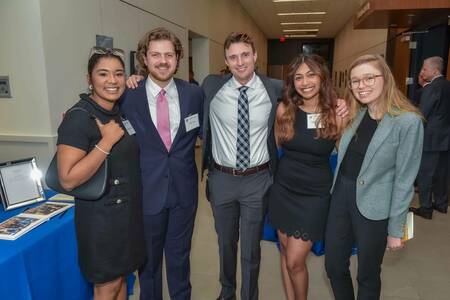
The Notre Dame Clerks
And Wilson remembers his collegiate roots. He has hired 38 clerks who are graduates of Notre Dame Law School, two who have master's degrees from Notre Dame, and eight who are Notre Dame undergraduate alums.
Holly Lanchantin ’22 J.D., clerked for Wilson in 2022-23 and noticed how his kindness and welcoming nature resonated with the courthouse staff and people in the community.
"He's more of a listener than a talker. And watching him on the bench, he is very even-keeled. It's hard to tell the way he will judge a case if you just watch from the gallery because he is very reserved. And I think that's really powerful," said Lanchantin, an assistant attorney general for the State of Illinois. "I try to emulate him in my career and how I tend to interact with judges—listening more than talking, choosing my words carefully, and speaking slowly."
Matthew Duffy '07, 13 J.D., clerked for Wilson in 2013-14 and remembers the Mondays after Notre Dame football games when the casual discussion in Wilson's chambers centered on the game.
"For the clerks who were not Notre Dame fans, they quickly became fans. Judge Wilson is an incredibly optimistic Notre Dame fan," said Duffy, a litigation partner at Kellogg Hansen in Washington, D.C.
In the courtroom, Duffy noted that even though the practice of law is "often contentious and people have sharp elbows, Judge Wilson was always respectful and collegial. People would have disagreements on paper, but everybody could still be friendly and collegial. He did a great job throughout the Eleventh Circuit, fostering mutual respect. It's really a core value to him."
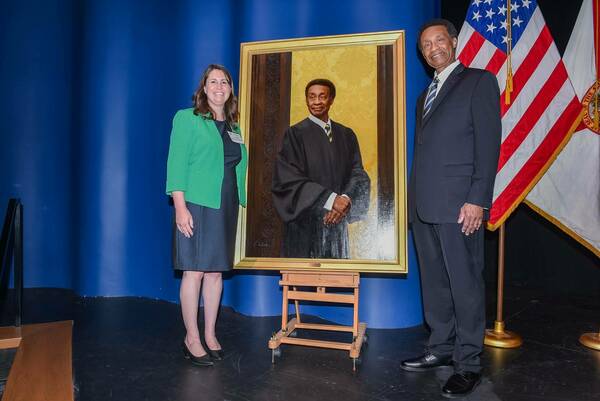
Michelle Letourneau-Belock '12, 15 J.D., also remembers Wilson's thoughtfulness, careful listening, and ability to exude calmness.
"In oral argument, Judge Wilson listens carefully and treats counsel with respect, trying to work with everyone in the room to come to the right answer legally," said Letourneau-Belock, an assistant general counsel at Notre Dame who clerked for Wilson 2015-16.
"While he is deeply thoughtful about the legal issues, he also keeps in mind the human element that's at the heart of each case being brought. For the parties involved, this case and having a decision from the court in an efficient manner are very important."
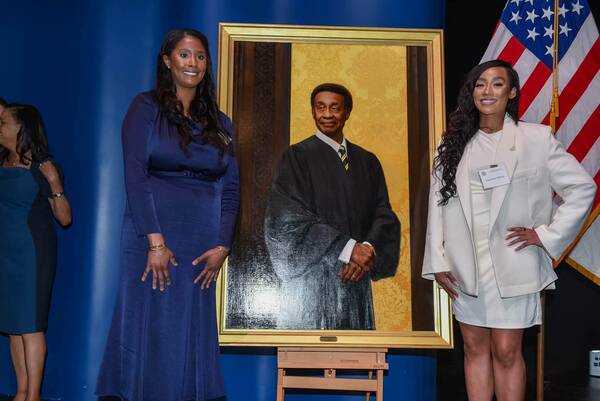
When he's not working, Wilson enjoys following Notre Dame sports and spending time with family. He has passed down his affection for the university and the rule of law to his daughters, Courtney Wilson '07, and Kendall Wilson '14 J.D., who both have degrees from Notre Dame and are practicing lawyers.
Looking back on his time at Notre Dame, Wilson remembers the emphasis on professionalism, integrity, and service.
"It has been my experience that the most important asset that a lawyer or judge can have is your reputation for integrity. Notre Dame and Jesuit High School reinforced values that were instilled in me by my mother and father. Although the term was coined after I graduated, I guess that is what we mean by a 'different kind of lawyer,'" he said.
"I hope," Wilson said, "that my legacy will be that I decided cases fairly, impartially, and decisively, based on the law and facts, without any particular ideological predisposition."
- Written by Pat Milhizer