Inaugural Death Penalty Abolition Week Brings Together Exonerees, Advocates, and Faith Leaders
From conversations on wrongful convictions and systemic failures to reflections on faith, justice, and mercy, Notre Dame Law School’s inaugural Death Penalty Abolition Week invited the Notre Dame and broader South Bend community to engage deeply with one of the most urgent human rights issues of our time. The four-day series of events, held in March 2025, aimed to confront the realities of wrongful convictions and spark critical conversations about the use of the death penalty, marking the beginning of an annual event.
During Death Penalty Abolition Week, distinguished speakers—including exonerees, advocates, and experts committed to criminal justice reform—shared firsthand accounts and examined the systemic issues tied to wrongful convictions and capital punishment, including racial bias against defendants of color and the fundamental violation of human dignity.
Notre Dame Law School was honored to feature as speakers Dr. Yusef Salaam, Central Park Five exoneree and New York City Councilman; Ohio death row exoneree Lamont Hunter and his attorney, Erin Gallagher Barnhart ’05 J.D.; Syl Schieber ’72 M.A., ’74 Ph.D., a leading voice for the abolition of the death penalty; and Sister Helen Prejean, author of Dead Man Walking: An Eyewitness Account of the Death Penalty in the United States.
The events throughout the week were organized by the Notre Dame Law School Exoneration Justice Clinic and the Klau Institute for Civil and Human Rights, and co-sponsored by several student organizations.

Yusef Salaam, Central Park Five Exoneree and New York City Councilman, Delayed But Not Denied
Dr. Yusef Salaam, one of the Exonerated Five and a New York City Councilman, opened Notre Dame Law School’s inaugural Death Penalty Abolition Week with a deeply personal and urgent reflection on his wrongful imprisonment. At just 15 years old, Salaam was falsely accused of a brutal crime in Central Park in New York City, tried as an adult, and sent to prison at 16. “They looked at the color of my skin and not the content of my character and deemed me guilty,” he told a packed room, highlighting how racism and media-driven narratives shaped his fate and that of four other Black and Latino boys. He described his case as a “love story between God and His people”—a reminder that while the truth can be buried, it cannot be destroyed.
Salaam closed with a challenge to students: to live with purpose, reject apathy, and see themselves as part of a long generational fight for justice. “I need you to be a master strategist in your approach, because this is not a short-term game,” he said. Urging them to treat their lives as a baton passed to future generations, Salaam emphasized that vision, resistance, and intention are the true cure for a broken system.

Death Row Exoneree Lamont Hunter and His Attorney Erin Barnhart
On the second day of Death Penalty Abolition Week, Ohio death row exoneree Lamont Hunter and his attorney, Erin Gallagher Barnhart ’05 J.D., shared the emotional and legal journey that led to his release after nearly 18 years behind bars. Hunter was convicted in 2007 in connection with the death of his 3-year-old son. He was ultimately freed in 2023 after newly discovered evidence cast doubt on the original forensic conclusions, leading the state to vacate his capital convictions. He then accepted a plea deal to lesser charges and was released with time served.
Hunter spoke candidly about the emotional toll of incarceration and the decision to accept the plea deal—not for financial restitution, but for the sake of truth and family. Now free, Hunter continues to rebuild his life and speak out against the flaws of a system that failed him at every turn, costing him nearly everything.

Erin Gallagher Barnhart ’05 J.D. serves as the assistant federal public defender for the Southern District of Ohio’s Capital Habeas Unit. In her work, she represents death row inmates in federal habeas, civil rights litigation, and state clemency matters. While at Notre Dame Law School she was an editor of the Notre Dame Law Review and earned the Farabaugh Prize for High Scholarship in Law.
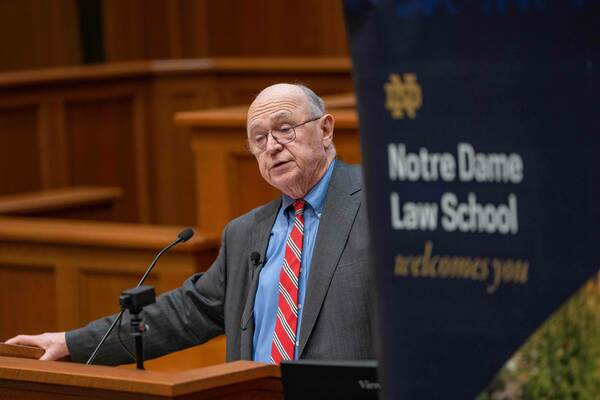
Syl Schieber, When the Death Penalty Got Personal
On the third day of Death Penalty Abolition Week, Syl Schieber ’72 M.A., ’74 Ph.D., shared a powerful testimony rooted in faith, forgiveness, and justice. After his 23-year-old daughter, Shannon, was raped and murdered in 1998, Schieber and his wife, Vicki, made the decision to oppose capital punishment for her killer—a decision grounded in their Catholic faith and belief in the sanctity of human life. In the years since, Schieber has become a prominent voice in the movement to abolish the death penalty nationwide.
Dean G. Marcus Cole opened the event by affirming the Church’s call to oppose the death penalty, saying, “I’m proud that Notre Dame Law School stands with our Church and with Syl Schieber in following the command of Christ to fight for the abolition of the death penalty and to recognize the human dignity of every human life as created in the likeness and image of God.”
Schieber echoed Cole’s message, underscoring the central role that faith and forgiveness play in his life. “If you can’t stand by your principles when it’s difficult, then they’re not your principles,” said Schieber.

Sister Helen Prejean, The Sanctity of Human Life
Sister Helen Prejean closed Death Penalty Abolition Week with a powerful story of how she was unexpectedly drawn into her life’s mission. What began as volunteering to write letters to a death row inmate, Patrick Sonnier, ended with her accompanying him to his execution as his spiritual adviser. “I came out after watching Pat be killed and the first thing I did was throw up. But that’s also when the mission to talk to all of you about this issue began. I’m a witness,” she said.
Since that moment, Sister Helen has become one of the world’s most influential voices against capital punishment. Calling it “an extreme physical and mental assault on someone who’s been rendered defenseless,” she described death row as a form of torture and challenged students to confront its moral implications: “The death penalty is about us. We should not identify a human being solely with the worst act of his or her life.”
Sister Helen’s talk capped a powerful week of events that brought together exonerees, lawyers, advocates, students, faculty, and the broader South Bend community to confront the moral and legal challenges of the death penalty.