A Vocation Pursued: U.S. Supreme Court Justice Amy Coney Barrett

When Justice Amy Coney Barrett ’97 J.D. returned to Notre Dame Law School in late August 2025, it wasn’t as a guest cloaked in the formality of the nation’s highest court. Instead, she stepped back into familiar halls she knew as a student, teacher, mentor, and colleague—as a member of the Notre Dame family.
For Justice Barrett, Notre Dame has always felt like home. It’s where she earned her law degree, graduating with the distinguished Hoynes Award; where she discovered her calling to teach and spent nearly two decades shaping the minds of future lawyers; and where she returned to the classroom, even while serving on the U.S. Court of Appeals for the Seventh Circuit and on the U.S. Supreme Court.
During her August visit, Justice Barrett taught a short course on Modern Constitutional Theory, sat down with CBS’s Norah O’Donnell to discuss her new book, Listening to the Law, and visited family, friends, and colleagues.
In a wide-ranging conversation with Notre Dame Lawyer magazine, Justice Barrett considered how her years at Notre Dame—as both a student and a faculty member—continue to shape her life on and off the Supreme Court.

Answering the Call
When the opportunity came in September 2020 about a possible Supreme Court nomination to replace the late Justice Ruth Bader Ginsburg, Justice Barrett admitted her first reaction was not one of immediate excitement.
“I had a pit in my stomach,” she recalled. “I knew the confirmation process would be difficult at best, brutal at worst.”
She and her husband Jesse gave the matter considerable thought. “It was an opportunity to serve the country, and the things that were going to be hard about it for me would have been hard for whoever said yes. So it seemed selfish if that were the only reason not to do it.”
Plus, the decision wasn’t about ambition. It was about vocation.
“It just felt like a way to serve, a way of thinking about law as a vocation. If this was a way to serve the country and to put my skills and talents to use for the rule of law, then I should be open to doing that.”
Both she and Jesse knew that once she accepted the nomination, there would be no turning back. Still, the personal sacrifices were significant. Leaving South Bend, where the Barretts have deep roots, a thriving family life with seven children, and close ties to both the community and the Law School, was the hardest part.
“We were very happy in South Bend,” she said. “We were giving up a community we loved. And I was still very rooted in the Notre Dame community.”
Strength of the ND Community
As she stepped onto the national stage in a very public way, Justice Barrett felt the strength of the Notre Dame community behind her.
“It meant a lot to me that Father Jenkins came to the Rose Garden ceremony,” she said. That support from the University wasn’t new. During her 2017 nomination to the U.S. Court of Appeals for the Seventh Circuit, Justice Barrett faced pointed questions, some about her faith.
“It’s not that everyone at Notre Dame, or every alum of Notre Dame, was supportive of my nomination. And that’s fine,” she explained. “But it meant a lot to me that when I was attacked specifically for my faith, Notre Dame stood up for me, that Father Jenkins stood up for me.”
Her Seventh Circuit appointment also drew robust support from her Notre Dame Law School colleagues. In a letter endorsing her nomination, every full-time faculty member signed a collective statement praising both her intellect and character. One part read: “She possesses in abundance all of the qualities that shape extraordinary jurists: discipline, intellect, wisdom, impeccable temperament, and above all, fundamental decency and humanity.”
That same spirit of community carried forward when she was later considered for the Supreme Court. The circle of support expanded, including hundreds of former students, co-clerks from the Supreme Court, faculty, and alumni from across ideological lines.
As a group, hundreds of Notre Dame Law alumni wrote in a letter to the U.S. Senate that their support reflected not politics, but gratitude: “We have come to know and love Judge Barrett not for her impressive credentials, but for her presence, enthusiasm, and intellect as a faculty member at Notre Dame Law School.”
Justice Barrett commented on that spirit of belonging. “I think that the sense of a Notre Dame community of belonging, loyalty to one another, and friendship is pronounced here,” she said. “There’s also a sense that you can disagree and have different politics or views about public policy but still respect one another as people.”
At Home and On the Court

Behind the pillars of the Supreme Court, daily life is smaller and more personal than many expect.
“It’s a very small branch of government. Nine officials, each with four law clerks. It is a place where you see one another and interact a lot. There are warm feelings, even though there are strong disagreements,” Justice Barrett said.
In her book, Justice Barrett discussed the importance of engaging across differences. She likened her family of nine to the nine members of the Supreme Court, recognizing that there will be differences. She said that while it might be easier to avoid people whose beliefs differ from her own, it would make life “less rich by excluding wonderful people from it.” Sparring with intellectual opponents, she noted, is “the way to hear the other side of the argument.” Such engagement isn’t optional on the Supreme Court.
“Because the Court cannot function without collegiality, the work drives home the importance of balancing a commitment to ideas with a commitment to respond to people who don’t share them,” she wrote.
Justice Barrett added that life on the Supreme Court can quickly become insular. “It would be very easy to become isolated or to think of yourself as defined by your job,” she said.
Contributing to this insular aspect is the level of security required and a sense of confinement, which is much more pronounced than when she clerked for the late Justice Antonin Scalia during the 1998–99 term. Justice Barrett said it is one of the most surprising changes since her days clerking.
For her, the necessary security started abruptly on the Saturday before her nomination. The press had already started camping outside her home. She had plans to attend one of her children’s soccer games and make a Costco run—simple things she would normally do on her own. “Well, I didn’t go to the soccer game and I didn’t go to Costco.” Laughing, she added, “I didn’t even know that it would have been the last time I would go to a soccer game or to Costco and drive myself.”
“It was an opportunity to serve the country, and the things that were going to be hard about it for me would have been hard for whoever said yes.” – Justice Barrett
While the bubble of security and official events can create a sense of distance from ordinary life, Justice Barrett said what helps her stay grounded are the familiar rhythms of home and her life as the same regular mom—doing all of the same things for her younger children now that she did for her older ones before she was on the Court—cooking dinner, cheering from the sidelines at soccer games, volunteering at their school, and joining in family traditions. Those everyday moments, she reflected, make it hard to think of herself solely through the lens of being a Supreme Court justice.
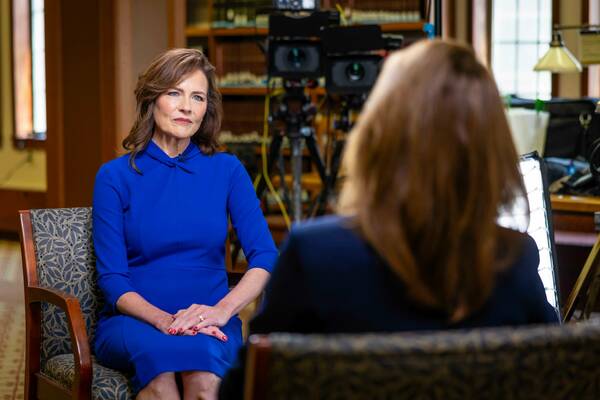
A Different Kind of Lawyer
As a member of the Class of 1997, Justice Barrett was drawn by the school’s sense of mission and community. “I chose Notre Dame because it was a place that valued academic excellence. At the same time, there is also an emphasis on thinking of your life in terms of vocation and working for the common good.”
She resists the suggestion that Notre Dame has shaped her identity as a justice. Instead, she said, it has shaped her identity as a person. Her decision to attend Notre Dame mirrored her belief that law is not something separate from life, but is part of a larger calling.
Even at the height of her judicial responsibilities, Justice Barrett continues to see law through the same lens she brought to her classrooms at Notre Dame.
A beloved and respected teacher during her 23 years on the Notre Dame Law School faculty—15 years as a full-time faculty member and several more on an adjunct basis—Justice Barrett was named by students as the Distinguished Professor of the Year and delivered the commencement address in 2006, 2016, and 2018.
In her 2006 address to graduates, Justice Barrett reflected that being a different kind of lawyer isn’t about mastering a different body of law or choosing a particular career path.
“Being a different kind of lawyer means recognizing that law is just one part of your life—one part of your vocation. This is part of the Catholic mission to do your work to the best you can, while recognizing that your work takes place in the larger context of life, which includes your family, your faith, and your friendships,” she said.
For Justice Barrett, vocation has meant service to the country. For her students, it may mean public interest, private law, or nonprofit work, but the core mindset remains. She says, “Your motivations should be focused outward on service, in whatever shape that takes.”
A decade later, in her 2016 commencement remarks, she returned to that theme, urging graduates to measure success not by comparison but by integrity and purpose.
“Don’t lose time or happiness by comparing yourself to those on your right or your left. Look straight ahead and run your best,” she said.
Her message—to approach law as a calling rooted in service and integrity—is one her students still carry with them.
Teacher, Mentor, Notre Dame Lawyer
Former Dean Patricia O’Hara was dean when Justice Barrett joined the Notre Dame faculty in 2002. During her 2020 Senate testimony introducing Justice Barrett she noted, “Our students, then and now, hold her in awe for the power of her intellect and for her consummate professionalism.”
“This is part of the Catholic mission, to do your work to the best you can, while recognizing that your work takes place in the larger context of life, which includes your family, your faith, and your friendships.” – Justice Barrett
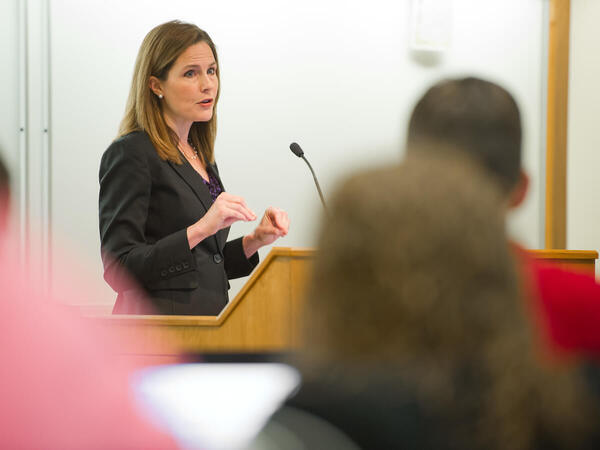
Kari Lorentson ’19 J.D. served as a research assistant for Justice Barrett while at law school and clerked for her at the Supreme Court. She said, “Over the years, I’ve had the privilege to witness Justice Barrett’s impressive work ethic and relentless dedication to getting the law right regardless of outcome,” said Lorentson. “How Justice Barrett approaches her role as a judge has instilled in me the importance of hard work, thoroughness, and attention to detail.”
Lorentson recalled often chatting with Justice Barrett along with her fellow law clerks during lunch about their goals, both professional and personal. Now an associate at Jones Day in Washington, D.C. and also a mother, she said, “I’ve always appreciated her guidance to not let your work as a lawyer take control over the most important things in life, like family. Finding that balance can be challenging at times, and I’m so grateful to have Justice Barrett as a role model.”
Lorentson added, “Though her titles have changed, she remains the same person: a rigorous academic, a generous mentor, and a kind person.”
Even amid the demands of the Court, Justice Barrett said she still loves being a teacher.
“I enjoy thinking about material and then trying to make it accessible, to help make it clear for students, to show them where the hard issues are, and to get them to think critically.”
She has returned annually to teach since joining the Supreme Court, offering one-week intensive courses. While a full-time tenured faculty member, she taught Civil Procedure, Evidence, Constitutional Law, Constitutional Theory, Federal Courts, and Statutory Interpretation.
“No one learns to be a lawyer in a vacuum. They learn because lawyers who are more experienced show it to them. I truly enjoy doing that for law clerks and law students,” Justice Barrett said.
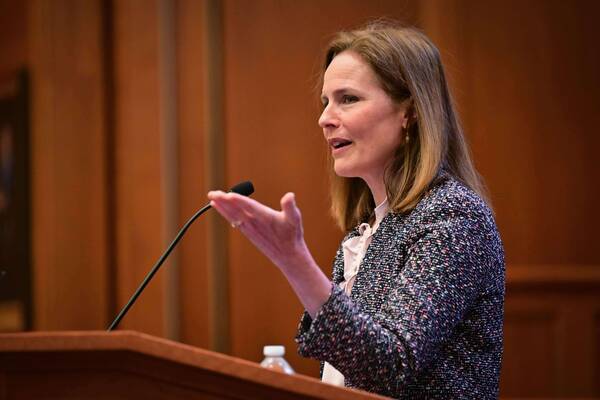
Shaping Trajectories
That commitment to teaching has left a lasting mark on her former students. Laura Wolk Slavis ’16 J.D.—the first blind woman to clerk on the U.S. Supreme Court—has spoken often of Justice Barrett’s mentorship and friendship. During Wolk Slavis’s first year of law school, when her assistive technology hadn’t arrived and her laptop failed, Justice Barrett stepped in to help. “This is not your problem anymore, it’s mine,” Justice Barrett told her, taking ownership of the problem and ensuring it was resolved.
Years later, Wolk Slavis testified during Justice Barrett’s confirmation hearings: “In part because of her unwavering support, I am the first blind woman to serve as a law clerk on the Supreme Court.”
Her story is one of many that illustrate Justice Barrett’s personal investment in her students and the values she continues to model on the bench.
A former Catholic school teacher and ACE Teaching Fellow, John Schoenig ’98, ’00 M.Ed., ’10 J.D. said his time in Justice Barrett’s classroom—and the encounters they’ve shared since— fundamentally shaped the trajectory of his career.
“Of all the teachers I have ever studied under, and indeed of all the teachers I have ever observed, Justice Barrett stands alone,” he said. “She helped me to take my vocation seriously, to share whatever gifts I have with those who need them most, and to be comfortable laughing at myself.”
Mind, Heart, and Soul
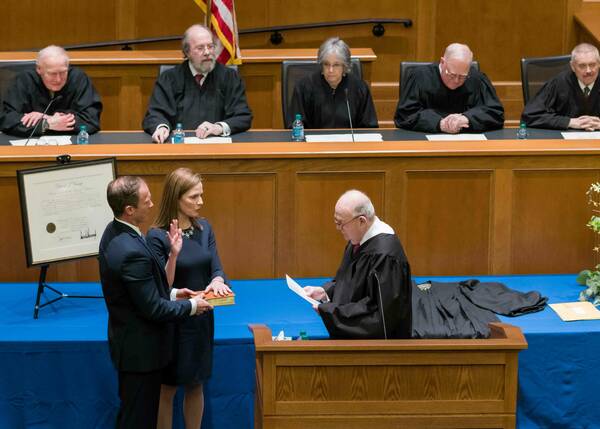
As Justice Barrett just celebrated her fifth year on the Supreme Court, her personal ties to Notre Dame remain strong. She returns often to visit friends and favorite spots on campus, and loves cheering on the Irish in the fall.
“I am very grateful for my Notre Dame education. I met my husband at Notre Dame. I had the opportunities that I had because I had mentors on the faculty. Notre Dame has been a place that has not only encouraged my faith and helped me to be an excellent lawyer, it’s also given me friends. It’s given me the privilege of teaching so many students over the years. It’s given me a place that I can always come back to,” Justice Barrett said.
As former Dean O’Hara once observed, Justice Barrett’s life reflects the same wholeness she teaches her students to pursue: “Amy Coney Barrett is a woman who leads an integrated life of mind, heart, and soul, and it’s that integration that allows her to move so seamlessly between her professional responsibilities and her family commitments.”
Musing about what she hopes to feel at the end of her career, Justice Barrett said, “I can’t be confident that I will make the right decision in every case. In fact, I think I can be confident that I will sometimes get it wrong. But I hope that I can truly say at the end that I have done my best, that I have always conducted myself with integrity, and that I have been fearless and never made a decision other than one that I thought the law required.”
For Justice Barrett, vocation, faith, and service are not separate tracks—they converge in how she lives both her public and personal life. She remains a Notre Dame Lawyer, committed to integrity, humility, and purpose.
- Written by Denise Wager