Jimmy Gurulé
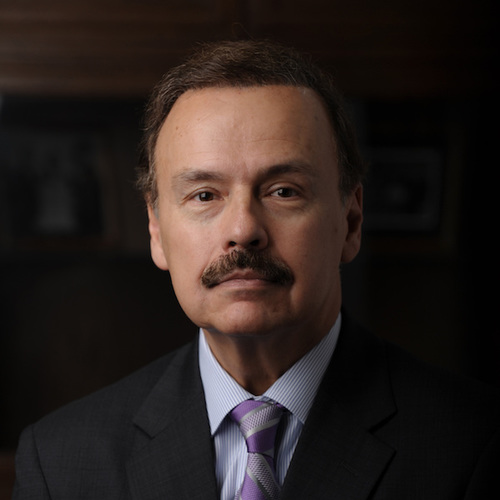
Professor of Law
Faculty Director, Exoneration Justice Clinic
Office: 2119 Eck Hall of Law
Phone: 574-631-5917
Fax: 574-631-4197
Email: Jimmy.Gurule.1@nd.edu
Staff Assistant: Claire Shely
CV: View
Jimmy Gurulé is an expert in the field of criminal law, international criminal law, terrorism and terrorist financing, and national security law. He served as Associate Dean for Academic Affairs in 1998-1999.. A member of the Indiana and Utah State Bar, Gurulé has worked in a variety of high-profile public law enforcement positions including as Under Secretary for Enforcement, U.S. Department of the Treasury (2001-2003), where he had oversight responsibilities for the U.S. Secret Service, U.S. Customs Service, Bureau of Alcohol, Tobacco, and Firearms, Financial Crimes Enforcement Network, Office of Foreign Assets Control, and the Federal Law Enforcement Training Center; Assistant Attorney General, Office of Justice Programs, U.S. Department of Justice (1990-1992); and Assistant U.S. Attorney, where he served as Deputy Chief of the Major Narcotics Section of the Los Angeles U.S. Attorney’s Office (1985-1989). Among his many successes in law enforcement, Gurulé was instrumental in developing and implementing the U.S. Treasury Department’s global strategy to combat terrorist financing.
Gurulé concentrates his teaching and scholarship in the areas of criminal law, teaching courses in international criminal law, national security law, and evidence. He co-authored National Security Law and the Constitution (Wolters Kluwer 2d ed., 2020), National Security Law, Principles and Policy (Wolters Kluwer 2d ed., 2019), Handbook of Criminal and Terrorism Financing Law (Palgrave McMillan 2018); International Criminal Law (Carolina Academic Press) (4th ed. 2013); Criminal and Forensic Evidence (LexisNexis) (4th ed. 2013); Complex Criminal Litigation: Prosecuting Drug Enterprises and Organized Crime (forthcoming 4th ed. 2019); Principles of Counter-Terrorism Law (Thompson-West 2011); and authored Unfunding Terror: The Legal Response to the Financing of Global Terrorism (Edward Elgar 2008).
An internationally recognized expert in the fields of terrorist financing and anti-money laundering, he has delivered lectures on these subjects before: the Italian Banker’s Association, Milan, Italy; Military Center for Strategic Studies, Rome, Italy; Austrian Defense Academy, Vienna, Austria; Euroforum, Madrid, Spain; World Economic Forum, Davos, Switzerland; Indian Banker’s Association, Calcutta, India; Institute for International Bankers, New York City, and Comandancia de la Policia Nacional, Asuncion, Paraguay.
Gurulé is the Director of the Exoneration Justice Clinic. He serves on the Board of Directors of the USAID Rule of Law and Cultural Integrity in Paraguay initiative, elected as a Fellow of the National Academy of Public Administration (2009), and selected as a member of the United Nations expert working group on “Public Corruption and the Negative Impact of the Non-Repatriation of Funds of Illicit Origin on the Enjoyment of Human Rights.” He has served as a consultant to the American Bar Association Rule of Law Initiative advising the governments of Armenia, Belize, and Bahrain on criminal justice reform. Gurulé has also served as an expert witness and consultant on several high-profile anti-money laundering and counter-terrorism cases, including the 1983 terrorist bombing of the U.S. Marine barracks in Beirut, Lebanon, 1998 terrorist bombings of the U.S. embassies in Kenya and Tanzania, and 9/11 terrorist attacks.
Gurulé is a prominent member of the Hispanic legal community, having served as President of the Hispanic National Bar Association in 1989 and received the Graciela Olivarez Award in 2006. He received the Distinguished Professor of the Year award in 2021.He has been quoted by the New York Times, Wall Street Journal, Washington Post, Chicago Tribune, Christian Science Monitor, Bloomberg, Associated Press, and interviewed by CNN, CNN International, CNBC, NPR, CBS, FOX, and the BBC.
Watch the Notre Dame Fighting for Justice video featuring Gurulé. He was the subject of a faculty profile broadcasted nationwide during half-time of the September 27, 2008 Notre Dame v. Purdue football game. He was one of six faculty profiles aired during the course of the season.
Gurulé was selected as a Fulbright Scholar and spent the Spring semester 2011 studying and teaching in Santiago, Chile.
Courses Taught
- LAW60302, Criminal Law
- LAW70205, Criminal and Forensic Evidence
- LAW70324, National Security Law
- LAW70403, International Criminal Law
- LAW70434, Law of Terrorism London: International Criminal Law
- Death Penalty Seminar
- Wrongful Conviction Externship
Scholarship
Books
National Security Law and the Constitution (Wolters Kluwer, 2021, 2nd edition).
National Security Law -- Principles and Policy (Wolters Kluwer, 2019, 2nd edition).
Complex Criminal Litigation: Prosecuting Drug Enterprises and Organized Crime (Juris Publ. 2019, 4th edition).
Handbook of Criminal and Terrorism Financing Law (Palgrave 2018).
Criminal & Forensic Evidence, with R.J. Goodwin (4th ed.) (LexisNexis, 2014).
Principles of Counter-Terrorism Law (Thompson-West, 2011).
Unfunding Terror: The Legal Response to the Financing of Global Terrorism (Edward Elgar Publ 2008).
International Criminal Law: Cases and Materials, with Paust, Bassiouni, Scharf, Sadat & Zagaris (Carolina Academic Press, 4th ed. 2013).
Human Rights Module: On Crimes Against Humanity, Genocide, Other Crimes Against Human Rights, and War Crimes (Carolina Academic Press 2006).
International Criminal Law Documents Supplement, with Paust, Bassiouni, Scharf, Sadat & Zagaris (Carolina Academic Press, 3d ed. 2006).
The Law of Asset Forfeiture, with S. Guerra-Thompson and M. O'Hear (LexisNexis, 2d ed. 2004).
Book Segments
Evaluating Progress in the Global War on Terrorist Financing in How to Combat Money Laundering and Terrorist Financing, (Richard Pratt ed., 2005).
Articles
Professor Gurulé has published numerous articles pertaining to criminal law, including:
Criminalizing Material Support to Domestic Terrorism -- A National Security Imperative, 47 N.D. J. Leg. 8 (2021).
The Failure to Prosecute ISIS's Foreign Financial Financiers Under the Material Support Statute (with Sabina Danek), The Palgrave Handbook of Criminal and Terrorism Financing Law, Chapter 41 (2018).
Utilizing Secondary Sanctions to Curtail the Financing of the Islamic State, Georgetown Journal of International Affairs XVIII (Winter/Spring 2017).
The Need to Refocus the U.S. Government's Post-9/11 Counter-Terrorist Financing Strategy Directed at al Qaeda to Target the Funding of ISIS, 50 Val. U.L. Rev. 493 (2016).
Holding Banks Liable Under the Anti-Terrorism Act for Providing Financial Services to Terrorists: An Ineffective Legal Remedy in Need of Reform, 41 N.D. J. of Legis. 189 (2015).
The Demise of the U.N. Economic Sanctions Regime to Deprive Terrorists of Funding, 41 Case W. Res. J. Int'l L. 19 (2009).
Does "Proceeds" Really Mean "Net Profits"? The Supreme Court's Efforts to Diminish the Utility of the Federal Money Laundering Statute, 7 Ave Maria L. Rev. 339 (2009).
Who Is Winning the War on Terror Financing?, 10:2 The Financial Regulator 25 (2005).
Unfunding Terror - Perspectives on Unfunding Terror, 17 Transnational Lawyer 113 (2004) (symposium).
U.S. Opposition to the 1998 Rome Statute Creating an International Criminal Court: Is the Court's Jurisdiction Truly Complementary to National Criminal Jurisdictions?, 35 Cornell Int'l Law Journal 1 (2002).
The 1988 U.N. Convention Against Illicit Traffic in Narcotic Drugs and Psychotropic Substances - A Ten year Perspective: Is International Cooperation Merely Illusory?, 22 Fordham Int'l Law Journal 74 (1998).
The Ancient Roots of Modern Forfeiture Law, 21 Notre Dame Journal of Legislation 155 (1995).
The Money Laundering Control Act of 1986: Creating a New Federal Offense or Merely Affording Federal Prosecutors an Alternative Means of Punishing Specified Unlawful Activity? 32 American Criminal Law Review 823 (1995).
Terrorism, Territorial Sovereignty, and the Forcible Apprehension of International Criminals Abroad, 17 Hastings International and Comparative Law Review 457 (1994).
Other Publications
The International Criminal Court: Complementarity with National Criminal Jurisdiction, 33 Amicus Curiae 21, Journal of the Society for Advanced Legal Studies (2001).
The Right to a Fair Trial, 28 European Commission for Democracy Through Law 95 (2000).
Does the CCE Statute Require Juror Unanimity on the Specific Predicate Drug Offense?, 5 Preview of U.S. Supreme Court Cases 251 (1999).
"Justice Delayed is Justice Denied": May a Prisoner's Challenge to Parole Revocation Be Delayed Until the Sentence Is Completed and Then Dismissed as Moot?, 2 Preview of U.S. Supreme Court Cases 106 (1997).
The Double Jeopardy Dilemma: Does Criminal Prosecution and Civil Forfeiture in Separate Proceedings Violate the Double Jeopardy Clause?, 7 Preview of U.S. Supreme Court Cases 325 (1996).
Cooperating with the Prosecutor: How Many Motions Does It Take to Secure a Sentence That Is Less Than the Mandatory Minimum Provided By Statute?, 5 Preview of U.S. Supreme Court Cases 242 (1996).
Multiple Punishment for Similar Crimes: Is the Double Jeopardy Clause Violated?, 3 Preview of U.S. Supreme Court Cases 104 (1995).
Areas of Expertise
- Criminal Forensic Evidence
- Criminal Law & Procedure
- Death Penalty
- Financial Frauds
- International Criminal Law
- Law of Terrorism
- National Security Law
- White Collar Crime